Feeds:
Posts
Comments

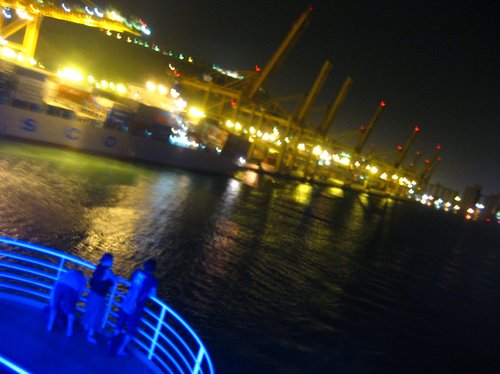
In a bid to minimise the number of flights taken on this sabbatical, Babs and I crossed the Mediterranean from Barcelona to Civitavecchia (the port of Rome) by taking a 20-hour Grimaldi lines ferry, which takes pedestrians, passenger cars and campers, and cargo trucks.

To economise we booked €55 deck seats instead of > €100 bunks, and they were fortunately comfortable enough for a decent sleep (picture business class seats on a mediocre airline). Savvier (but heavier laden) backpackers simply found free corners in the indoor deck, or curled up on the floor under their seats, and crawled into their sleeping bags padded by roll-up foam mats.

There was even a big-screen TV at the front of the room and I spent a very entranced hour watching CSI dubbed in Italian.

During the daylight hours, Babs and I settled into one of the cushy booths in the large bar/lounge where I did a lot of daydreaming, reading, writing and even napping to pass the time.

All in all, a very pleasant way to travel slowly, but a word of advice to those who are tight on budget but big on food: Drop by La Boqueria or Mercat Barceloneta and pack a picnic before getting on board, to avoid mediocre food priced for a captive audience.

Bye bye Barca. I miss you already.

IMG 0228

The ever irresistable Babs makes a new friend — a businessman making deliveries in Rome and Sardinia (we didn’t dare to ask what). In a mish mash of English, Spanish and French, we learn from him that Sardinia (which we wanted to go to but alas didn’t) was going to be as expensive as Rome anyway. Not to mention there were ongoing bushfires at the time.

IMG 0264

We eventually reach Civitavecchia at dusk, but still need to find the train station to catch a 90-minute connecting train to central Rome. Babs — not impressed with the organisation of the free port buses — turns on his internal “Babbinav” radar and rockets off on foot.

I plod along behind with backpack and daypack, and watch 3 port buses pass us by. Ah well. Might as well make the best of it and take in the sights of the Roman port along the way.

IMG 0282

A local fisherman — with ALL his goods on display — is as amused at the sight of me as I am of him.

IMG 0279

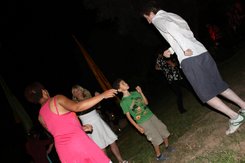
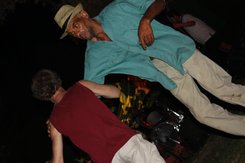
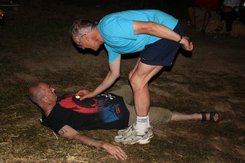
Just wanted to share a few of my favourite shots from our WWOOF host Catherine’s birthday bash during our last weekend in Orgiva, Spain.

The bandstand amid olive trees at night

IMG 2020

The band, fronting banners borrowed from a friend who designs and exhibits them for WOMAD festivals

IMG 1979

The DJs

IMG 2225

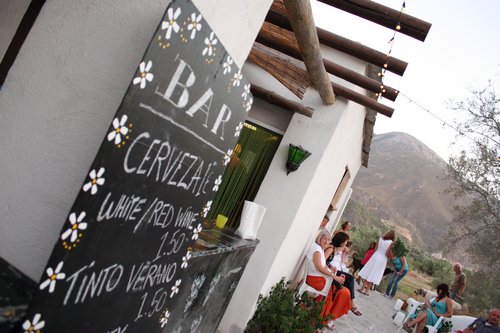
The bar on the back porch — manned in shifts by a series of guests, with the Sierra Nevada as backdrop

IMG 1997

“The beach” – sun loungers brought by UK friends set by the finca’s alberca (water catchment pool and natural swimming pool); shade assembled mostly by Babs, using only poles and string

IMG 1872

The guests

IMG 2002IMG 2081IMG 2151IMG 2158

And of course, the hosts. Happy birthday Catherine. Definitely a summer and a party to remember.

IMG 2206

IMG 0248

“I think I’ve died and gone to heaven. I’m not coming back. I love you, have a good life.”

So went the text I sent to fellow food dorks Kopibren and Melf the first time I stepped into Barcelona’s massive La Boqueria market on La Rambla a couple of years ago.

I can’t believe I let myself leave. (Who leaves heaven?!) Twice now. On both departures, the ever-unfolding cornocopia of treats both in the market and the neighbourhoods beyond left a growing, grating, gnawing feeling of unfinished business.

The only comfort – this means I’ll have to come back. Again. And again. And again.

Chances are, you’ll get to go before I do, so here are some highlights from what stood out most from my grazing haze. I know there’s plenty more I’ve yet to try, so let me know what made it to the heavenly spheres of your list and I’ll prioritise it for my next pilgrimage.

Boqueria Boogie

The first thing to do in Barcelona (and possibly also the 2nd, 3rd…and last thing) is to do a slow stroll along all the aisles of La Boqueria. The most cunning of visitors (e.g., my parents) rent a short-stay self-catering flat near the market so that their stomachs as well as their eyes can enjoy a VERY well balanced diet.

IMG 0160IMG 0220

Above, left: I’d always wondered what those little caps at the bottom of jamon legs were for. Up in Las Alpujarras, I learned that it was to catch dripping fat. Mmmmmm….

IMG 0225IMG 0147IMG 0150

Above, left: These strange looking tubular-with-a-beak shellfish are called percebes, or gooseneck barnacles. They thrive only on rocks heavily pounded by surf, so harvesting them is quite the task. They’re considered a big-time delicacy in Spain, usually steamed or served in soup. Apparently the Spanish have eaten through their domestic supplies, and now are heavy importers from Canada

IMG 0224

Above: Nice work if you can get it, being surrounded by a mushroom mountain all day

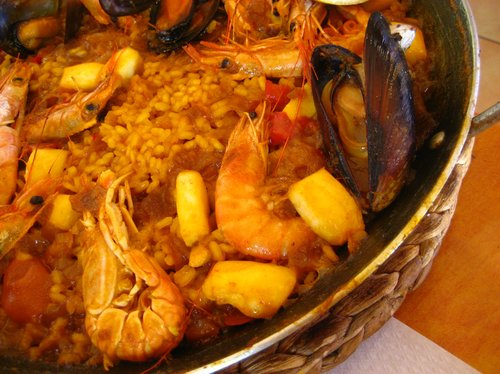
The done thing is to have tapas in the market, but you’ll need to get there early, or else be very patient, or else put sharp elbows to good use. To boost your civility batteries, consider digging into some paella on the perimeter on the market. It also helps you to tour the market without going completely mad or bankrupting myself… I mean… yourself.

This time around we went to Bar-Restaurant Galdric which served an excellent and generous paella for 2 for €22. Last time around I plonked down at a stall in the same area but I forget the name. You can’t miss it if it’s open — look for the colossal paella pan outside.
IMG 0138

IMG 0238

Crazy about Chocolate

IMG 0258There are plenty of smoothies, fruit salads and sweets at the market to tempt you for dessert. Or, you could wander a little east along Barri Gothic to Meson del Cafe, and indulge in a little churros and Spanish hot chocolate…the type that’s so thick you could pick it up it with a knife…

The Spanish take their hot chocolate pretty seriously. We learned at the Chocolate Museum in Bruges that back in the day when chocolate was the fashionable and exotic import from South America and available only to the aristocracy, Spanish ladies had their servants bring them hot chocolate even during mass. This to-ing and fro-ing caused so much disruption that hot chocolate was banned from church. Church attendance promptly plummeted.

Tapas Tip

Right. Tapas. Whatever list I put together for now will be grossly incomplete. And the thing is, there are plenty of marquee names that will charge you an arm and a leg (e.g. I’m still working up my wallet’s nerve to go to Cal Pep) and there are plenty of holes in the wall who will serve mediocre bites, microwaved after sitting on the shelf for a wee bit too long.

So, let me just send you to Cervesceria Cataluna in the Eixample distict, my favourite place for variety and value for money. There’s always a waiting list for tables, but the real action is up at the 2 bars. Stalk a bar stool, pounce fast and mercilessly (the locals will give the tourist no quarter) and rotate the 1 barstool among your group if you need to. As long as someone has access to the staff to order food, you be so distracted by the food you’ll barely notice you’re not sitting down.

I particularly enjoyed the grilled cuttlefish, grilled mushrooms, miniature sirloin steaks and burgers.

IMG 0309

IMG 0175

IMG 0176

Sweet Smelling

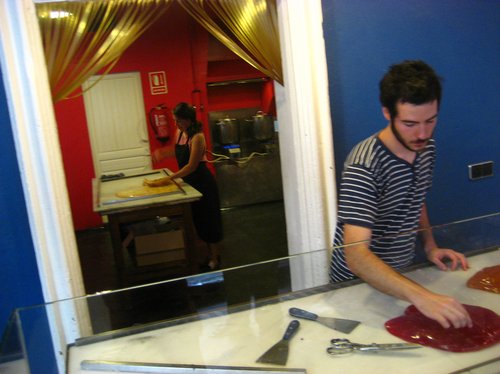
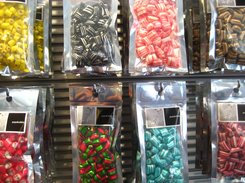
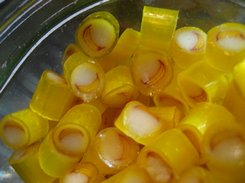
I found Papabubble quite by accident, by following the delightful scent of burning sugar down a few doors from our charming Hostel Blue on the bohemian C/ Ample. All the candy is made by hand onsite and make smart looking and tasty gifts for those who didn’t make it to heaven.
IMG 0183IMG 0189

IMG 0185

Walking it Off

In between meals, the best thing to do is to walk and soak in the art and the energy of the vibrant city.

IMG 0152IMG 0211

Above: The ongoing building of Gaudi’s La Sagrada Familia; youths playing football at Parc Guell, also by Gaudi.

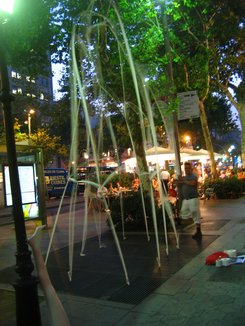
IMG 0214IMG 0163

Above: This nstallation down by Port Vell gets a cheeky toilet-paper response on Rambla de Catalunya

Below: My personal favourite, even if I’m the the one being railed against

IMG 0206

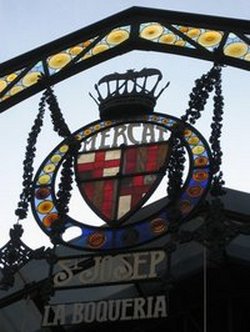
Mercat St Josep (La Boqueria)
La Rambla (Liceu station)

Restaurant Galdric
Passatge Virreina 2
08001 Barcelona, Spain
+34 685 580 922

Meson del Cafe
C/ Llibreteria 16 (Jaume I station)
08002 Barcelona, Spain

Cervesceria Catalana
C/ Mallorca 236
08008 Barcelona, Spain
+34 932 160 368

Papabubble
C/ Ample 28
08002 Barcelona, Spain
(Closed in August)
By Babs

Just a quick update – we reached Dubrovnik on Wednesday morning after a busy week of travelling, and are really enjoying it here! Admittedly on the basis of just two days in the country, I’d recommend anyone to visit Croatia and holiday here – good, inexpensive food, a beautiful coastline and city, the Adriatic is amazingly clean and clear and lovely for swimming in and overall it’s very relaxing here.

We left the farm at Orgiva a week ago on Tuesday, exactly three weeks after we arrived, and got a bus to Granada, from where we took a train to Barcelona, the first of several overnighters of the week. The Spanish train was comfortable though the cheapest tickets were for bunks in four berth single sex compartments. We stayed a night in Barcelona, ate some good tapas (lots of pulpo/octopus) and read by the beach. We skipped sightseeing as we’d both visited the more famous landmarks before and only had a day to spend in the city.

From there, we took a 20 hour overnight ferry (seats but no bunks this time!) to Civitavecchia, Italy then a train to Rome. We stayed in Rome for three nights and saw a few of the obvious things to see in Rome – the Colosseum, the Forum and the Vatican as well as too many other ancient monuments to list here! It seems you can’t walk anywhere in central Rome without bumping into either a two thousand year old monument or a renaissance building designed by Michelangelo. The sights were very impressive, but unfortunately we were put off by the extremely touristy feel of central Rome – it was very hard to find any shops, cafes or restaurants that weren’t trying to rip you off.

We spent a day in Bari next, having arrived on an overnight train from Rome, and took an overnight ferry that night to Dubrovnik. Not spending the night in Bari was a bit of a shame, because it turned out to be a really nice town. I had been assuming that it was just a port town but it had all the nice restaurants and pleasant Italian feeling that I’d been missing in Rome! We also discovered that travelling two nights in a row without anywhere to shower in the middle of summer tends to make one quite grouchy 🙂

Anyway, now we’re happy to be in Dubrovnik, and might even stay another night here!

Wen and Amir at the Sistine Chapel
Wabs looking at the ceiling of the Sistine Chapel.

IMG 0045

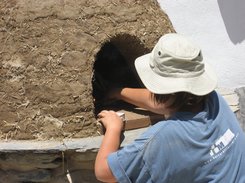
It was a labour of love, involving blood (mud-&-straw clumps scratching up our hands), sweat (building under the Spanish summer sun) and tears (when a supporting structure collapsed for the 3rd time).

An outdoor oven is one of those things Babs and I nurse ambitions about having someday, in that yet-to-be-identified place where we will eventually settle down (along with a massive charcoal BBQ pit and motorised roast spit). So I jumped at the opportunity to learn how to build one… by actually building one, while WWOOFING at Anthony and Catherine’s finca in Orgiva, Spain.

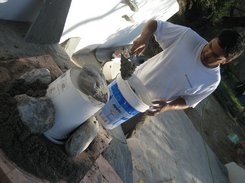
Our reference guide for the project was Build Your Own Earth Oven by Kiko Denzer. One of Denzer’s main principles is to use recycled and/or foraged materials, so that cost of building will tax neither your pocket, nor the envioronment. The only materials Anthony bought were ~30 firebricks (a few spare) and a few pieces of slate. The rest of it was sand from the beach in Motril, clay fand rocks from nearby riverbeds, and dirt and straw from the farm.

The Base

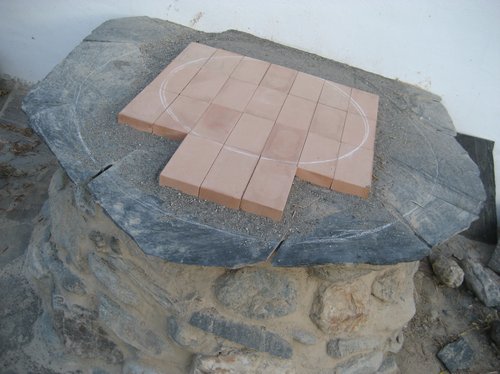
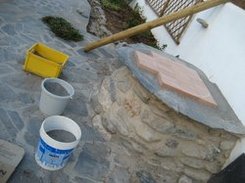
Anthony had already completed the base when we arrived. It’s a ringed stone wall, filled in with rubble. Right at the top it has insulating layers of clay and sand. The stone wall is self-supporting, but the crevices have been plastered up tight with mud and clay to prevent wasps from building nests in the gaps (The stone wall must have looked like a luxe condo block for waspy property hunters). On top of the slate are the firebricks (built denser than regular bricks to retain heat). This is the cooking floor of the oven.

IMG 0033

The Support Dome

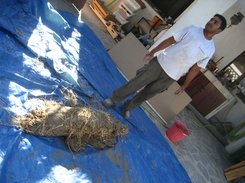
Question: If you’re building a dome which has a base radius of 33cm and a height of 48cm, how many buckets of sand from Motril do you need? Answer: Many more than you think.

In any case, the shortage was a great excuse to do a day trip to the beach. To improvise in the meantime, we bulked up dome volume with an upturned bucket, a few rocks and lots of gravel. It might have been due to this makeshift base, or the coarseness of the sand, or the startling evaporation rate, or one of our sandcastle building techniques (as Babs and I hotly debated) but we had 3 major sandslides before completion.

IMG 0032IMG 0036

IMG 0038IMG 0040

IMG 0066

Above: Babs VERY GINGERLY puts wet newspaper and sackcloth on the completed sand dome to help keep its shape while I hold my breath

The Baking Layer

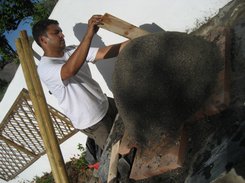
This first layer of mud and clay is what absorbs heat from burning wood in the oven, then radiates it back onto food. We had too much water in the mix, leading to lots of “flab” from sinking clay (what is it they say about ovens resembling their makers?). After it solidified sufficiently, Anthony did some nip tuck, and we marked out the door and scored the roof to help it bond with the next coming layer.

IMG 0065IMG 0070

IMG 0083IMG 0086

Additional Heat Retention Layer

Again this layer is made of mud and clay, but with straw mixed in. You can build an entire house out of this stuff, as is the case in various pockets of the English countryside, Africa, Central America and more recently Gaza.

Getting the straw to bond evenly with the mud is quite the task (Denzer recommends you get all the kids in the family or the community involved). Two people walking on it took too long, so we eventually blasted music from the house to get things really jumpin’.

IMG 0088IMG 0090

IMG 0091IMG 0099

IMG 0101IMG 0095

S6301033

Cutting Out the Door and Hollowing Out the Oven

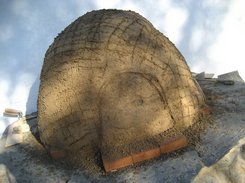
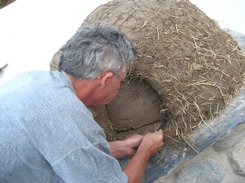
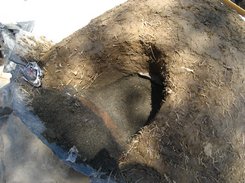
After running out of mud and straw for the day, we let the furry-winter-hat-looking structure dry out overnight. The next morning, Anthony and Babs debated about whether it was dry enough to cut out the door, and excavate the sand dome. Babs was convinced only after he personally conducted the very technical “squidge” test (3rd photo).

IMG 0001IMG 0003

IMG 0007IMG 0012

IMG 0023IMG 0026

Above: For those of you trying this at home: If you’re going to use an upturned bucket to pad out your base, make sure it’s not too much larger than the intended height of your door!

S6301062

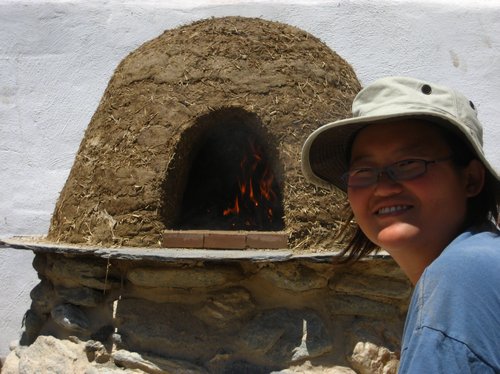
Above: Team WABS, our hosts Catherine and Anthony, and our functionally finished oven

Drying Out the Oven

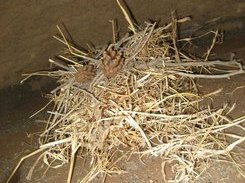
We now have a functional oven structure! There’s a 3rd layer (about 1-2 inches thick) that will eventually go on, but it’s mostly decorative. In the meantime, it’s time to start a little fire to dry out the oven from the inside. Babs and I can barely contain our pyro-glee as we slap together a clump of straw, twigs (2 sizes), a little log and a couple of pine cones for laughs. The team very graciously lets me light the flame. It burns beautifully. Babs and I spend the next hour just sitting on the floor staring at the flame and tossing in twigs and logs.

IMG 0029IMG 0027

IMG 0030IMG 0032

IMG 0034IMG 0037

IMG 0044

Our First Pizza!

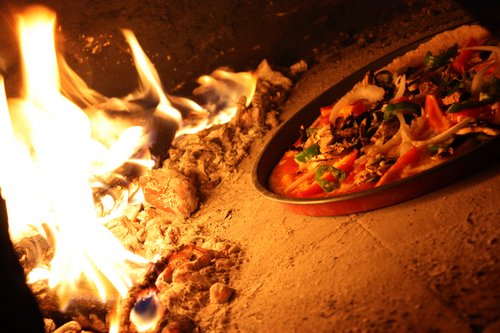
Given we’ll be needing to crank out pizzas for ~30 people this Saturday, the (ahem) professional thing to do was to test-drive the new oven for Monday night’s dinner. Current cooking time for 1 perfect pizza currently takes 5-8 minutes. The assignment for Wednesday lunch is to experiment with timing of pizza entry and burning-log placement, to reduce cooking time and improve even-ness of heat distribution. I forsee Babs and I insisting on a lot of practice.

If only all projects were this delicious and satisfying.

IMG 1859

IMG 1855

I’ve added a page (see top row of tabs) with a google map I’ve been working on with details of our route around the world. It’s got both the route we’ve taken so far and also the route we’re planning to take along with the corresponding dates. It’ll be updated as we go, so you can always check our latest itinerary plans on Where’s Wabs?

Posts on Restaurant Kursaal in San Sebastian and our quick stop in Granada are still in the works. In the meantime I thought I’d share a half-time report on our WWOOFing stint in Orgvia, Spain.

Early high points:

  • Orange juice from the oranges we picked just before lunch
  • Watching 1,000 yr old aquaducts built by the Moors water 400-yr-old olive trees
  • Plowing through our hosts’ bookshelves during siesta

Early low points:

  • Breathing so hard while working in the heat that you inhale a midge, and spend the rest of the day gagging on it, long after probably swallowing it
  • Weeds that beat you at tug-of-war

What on earth is WWOOFing?

WWOOF stands for World Wide Opportunities on Organic Farms. In summary you volunteer on an (often small) organic farm for an agreed number of hours a day and days a week, in exchange for food and accomodation. Along the way, you learn about different organic farming methods and sustainable living, as well as get an insider and rural view of the country you’re WWOOFing in. Your WWOOF host gets some sweat and muscle (and sometimes creativity and complementary knowledge) on the cheap. No money is exchanged, so no nasty work visa paperwork is needed. You pay a nominal WWOOF network membership fee to keep the network up and running.

This sounded like a genius proposition to Babs and me. We’d get to learn a little more about the food chain, AND stretch our travel budget. We decided Spain was a good place to start, and after writing to 12 hosts in various bits of the country, providence led us to a 3-week stint with Anthony and Catherine and their 3 acres of olive and orange trees in Orgiva.

Anthony and Catherine moved to Orgiva 2.5 years ago and have since built their house and the infrastructure around their homestead bit by bit, with plenty of patience and good humour. Before moving to Spain they spent the last 2 decades teaching children with special needs. I noted this with some optimism – perhaps they’ll have some patience for the occasional daftness of a lifetime city girl!

Orgiva Where?

IMG 0032

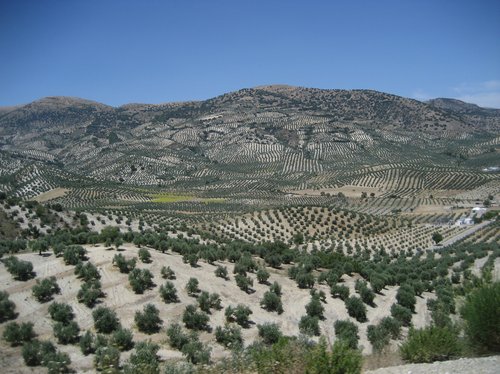
Above: This is an optical illusion of the idyllic farming life. Swaths of land planting just 1 type of crop creates chemical imbalances in the soil over time. The wide brown paths between the olive trees ease the way for the harvesting machine, but the exposed topsoil (where the nutrients are) is vulnerable to wind and flood erosion

Orgiva is the administrative capital of the Andalucia region, about an hour south of Granada in the foothills of the Sierra Nevada. It also turns out that Orgiva’s immediate surroundings — Las Alpujarras — are the setting of Driving Over Lemons by ex-Genesis drummer Chris Stewart, the first of his autobiographical Lemons Trilogy about uprooting from the UK and building a new life among peasant Spanish farmers.

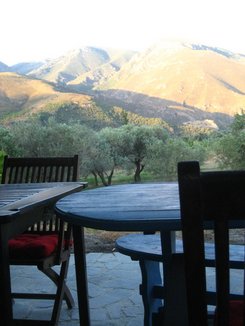
Two decades worth of Dutch, German and Brits — blackberry-beeping businessmen and barefoot-as-a-lifestyle-choice-hippies alike — decided the same, making the neighbourhood a strange little agricultural cosmopolis. It’s not entirely hard to see why. Below is the view from our breakfast table on the front porch, and a few peeks around our hosts’ garden.

IMG 0080IMG 0107

IMG 0014

IMG 0051

Where Do We Fit In?

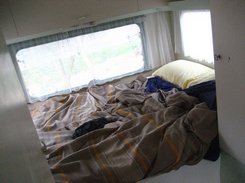
Specifically, in a 34-yr-old caravan in the back terrace of olive and orange trees, right next to a large patch of mint. So during the sweltering Spanish siesta, our caravan smells like Moroccan lemonade.

IMG 0078IMG 0077

IMG 0074IMG 0075

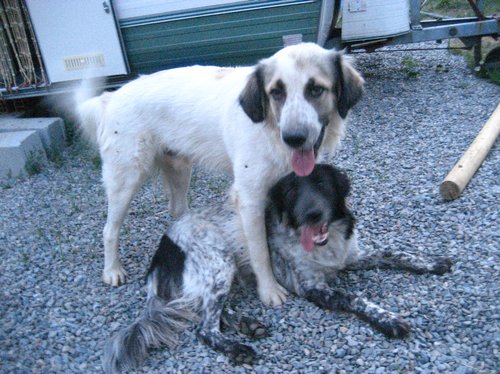
In addition to our hosts, we have dos chien Andalus, Zumba (the cream-coloured one) and his mother Oliva for regular company and entertainment. Hilarious when they’re horsing around, half as hilarious when Zumba bounds off with our solar torch in his mouth, usually at dusk.

IMG 0050

For our 3-week stint, we have 2 major projects: 1) Build an outdoor oven, and 2) Build a compost toilet. Both are partly a lead up to Catherine’s birthday weekend bash on July 18.

IMG 0031IMG 0020

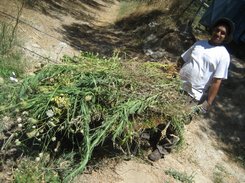
There are also the more day-to-day tasks of upkeeping the farm: Pruning trees, ripping out monster weeds choking up irrigation channels, and replacing knackered recycled wine and beer bottles around the vegetable beds.

IMG 0042IMG 0044

IMG 0047

Our day starts at 7.30am and we try and get in the heaviest tasks done before breakfast, before the sun really goes into overdrive. The shift between breakfast and lunch goes about 5 times as slowly and we’ve since learnt the art of tracking the path of the sun and planning our course for hopping between tree shadows to get as much done as comfortably as we can manage. We wrap up at about 1.30pm (it’s too hot to work after), have lunch, shower and pootle about for the rest of the day.

IMG 0046

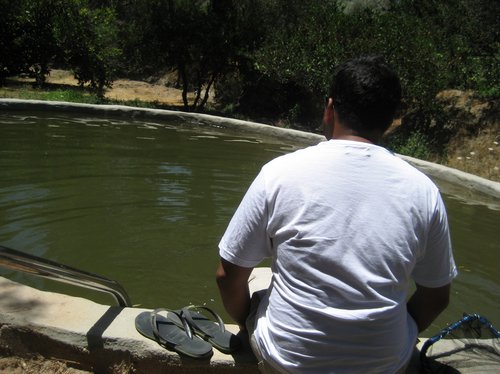
Above: Babs checking out our hosts’s alberca, part river-&-rainwater storage pond, part swimming pool.

So far, so good! Stay tuned!

Coming soon: Building a Bread Oven

Ola!

So it’s been 4 days of work on the farm and today’s an off day (we’re also taking tue off to go to the beach).

Major tasks have been getting materials ready to build an outdoor bread oven, building a concrete wall for a compost toilet, pruning olive trees and clearing monster weeds from the main irrigation channels to improve speed and volume of water going down to the trees lower down the slope.

We start at 7.30am and finish at 2pm cos it’s too hot to work after that. Hard work but very satisfying to see the results. Just not yet convinced I would want to do this long term (esp cos Babs and I are still wrestling with how it is at all economically sustainable). It’s a very pleasant lifestyle though, and I’m told the weather is ridiculously comfortable in spring and autumn.

Our hosts are vegetarian and obviously we eat what they eat, so all in all, am currently experiencing the healthiest lifestyle I’ve had, probably ever.

Am glad we’ll have another 2 weeks here (which culminates in one of the host’s birthday party). We’ll get to finish the bread oven and compost toilet, and the travel budget will be back in good shape (after the gluttony of San Sebastien)

P.S. Recently finished The Little Prince, and currently reading George Orwell’s Homage to Catalonia. Have always been an Orwell fan and this continues.

We visited Chris and Saskia who live in Heerlen, NL last weekend. Had a great time exploring Hasselt in Belgium where Chris picked us up from the station and where we found the yellow duckie, lunching in Maastricht, BBQing Saturday evening and riding in Saskia’s horse drawn carriage on Sunday morning. We spent all our spare time having fun playing with Saskia’s six (it used to be more!) Tonkinese cats.

Photos from the Netherlands

A quick one, not focused on food. Hopefully this provides a few helpful nuggets if you’re planning a visit to Bruges. If you’ve already been, and have advice to add (especially Bruge restaurant recommendations) I’d love to hear from you.

IMG 1571

A little Bruges sky thinking


Getting to Bruges

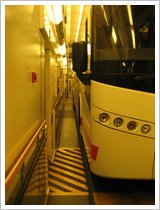
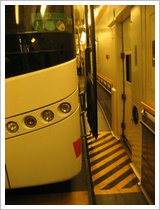
The closest international airport is Brussels, and from there it’s another 1 hour train journey to Bruge. If visiting from Europe, train lines are well connected. We took a 6 hr bus ride from London for £25 per person. The bus sat in a train carriage while going through the EuroTunnel. Kinda like a heavy transport version of turducken.

IMG 0110IMG 0115IMG 0116

Staying in Bruges

Bruge is a tiny walkable city, and the footpaths radiating around the old city are lush with flora and canals. So if on a budget, staying outside of the city gates might be a more value-for-money option. We paid €55 a night for a double-bed with ensuite bathroom.

Het Wit Beertje (their website shows photos that are pretty accurate)
Witte Beerstraat 4
Bruges

Our host Jean-Pierre Defour was friendly, attentive and served a generous breakfast of bread, vanilla custard pastry, meat, cheese and cucumber yoghurt (and fruit and yoghurt off screen).

IMG 0072

Getting around in Bruge

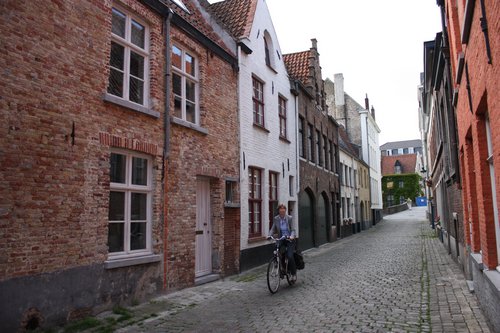
You can walk the entire old city in a day, and going on foot makes it easy to nip into quiet pretty little residential lanes.

IMG 1582

IMG 1585

Or for the full tourist experience, you can canter around town in a horse carriage or do a boat tour of the canals.

IMG 0011IMG 0030

Things to do in Bruge

Besides the usual art and city history museums, 4 slightly kookier options are the Haalve Maan Brewery Museum, the Diamond Museum, the Friet Museum and the Chocolate Museum. The latter 2 have many “exhibits” for tasting and the Chocolate Museum sells all kinds of moulds for home-based chocolatiers.

IMG 0018IMG 0023

IMG 1540IMG 1560

Five Fun Friet Facts, and then Farewell

  • Potatoes were largely shunned as poor man’s food when they were first introduced in England. Their market value rose only after a savvy farmer put fences and guards around his potato fields, making them seem valueable. Gotta love old school marketing
  • China is currently the largest global producer of potatotes, even though potatoes play no significant role in Chinese cuisine
  • Friets are allegedly a Belgian invention. Fishermen who caught and fried little minnows tossed potato bits into hot oil one harsh winter when the fish weren’t biting.
  • Friets ended up being called French Fries in America because some French-speaking Belgian soldiers offered them to some American soldiers during WWII. The Belgian soldiers never got around to correcting them, possibly because they didn’t think Walloon Fries sounded much better
  • Friets were traditionally fried in a mixture of beef fat and horse fat

For more research and ideas on Bruges, Wikitravel provides a well-researched write-up.