Feeds:
Posts
Comments

Just about when Babs was feeling like all these farmers markets looked a bit samey, my case for dawdling with a camera got renewed (whew!) when we came across these giant alien-looking discs at the traditional Stary Kleparz Market in Krakow, Poland.

After circling a few times, peering at them up close, and prodding them a little, we finally realised that these were, essentially, a large bag of sunflower seeds in their original packaging. (This may be far more obvious to some of you, but certainly not to this city girl at the time.)

IMG 1208

To put the above in context, here’s a sunflower in the middle of the seeding process, which I photographed at a flower show in Tallinn, Estonia, a couple of weeks later.

IMG 1701

Another first-time find at Stary Kleparz Market: these luscious tomato-shaped peppers.

IMG 1219

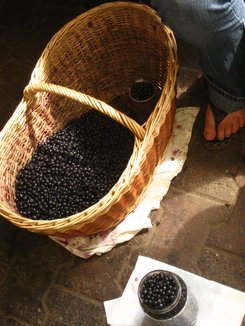
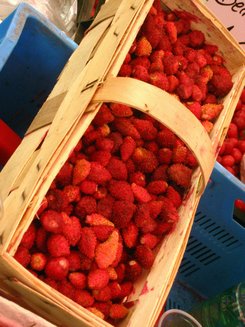
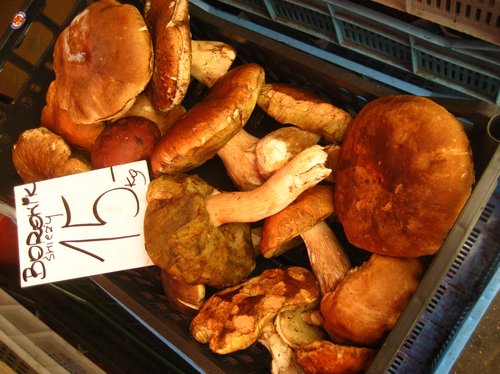
It being August at the time meant that locals were currently enjoying the best of 2 seasons: late summer berries, and early autumn wild mushrooms. Some stalls had mountains of both, but there were plenty of locals simply hawking just one basket of whatever they foraged or grew at home, e.g., blueberries and wild strawberries sold by the cupful.

IMG 1209IMG 1217

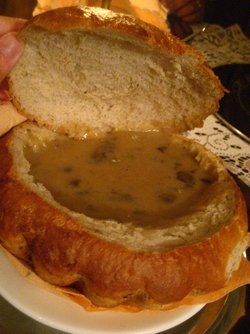
The lack of a kitchen pained me greatly when I saw these heaps of bulbuous porcini. Fortunately, the popular Polish restaurant U Babci Maliny (which delightfully translates as Grandmother Raspberry) served up a mushroom soup that did them justice (read the post here).

IMG 1211

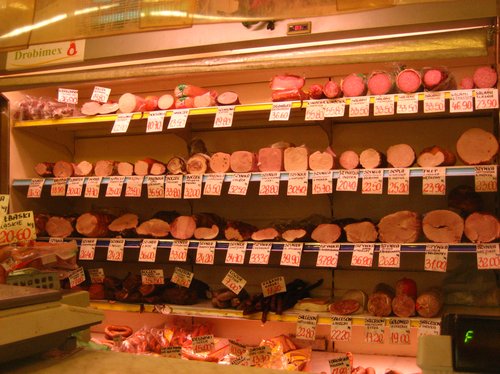
The Poles take their pork pretty seriously. I’m not sure I’ve seen a ham display this large anywhere else. Not even in Spain. Well, not this well organized, at least.

IMG 1224

IMG 1226Given Krakow is on Poland’s landlocked southern side, most of the fish we saw was smoked or pickled. Up north, freshwater fish such as carp, perch and eel from native lakes are popular picks for regional cuisine.

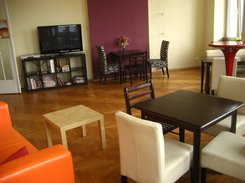
GlobArt Hostel , where we stayed, is just round the corner from the market, which made for cheerfully cheap and downright delicious lunches, with a view of Krakow’s Old Town.

IMG 1233

One of the (many) things I’m keen to do on this sabbatical is to learn how to cook traditional dishes from various cuisines, be it from a family’s keeper-of-recipes, or a professionally-run cooking class.

While in Istanbul, Babs and I had the opportunity to sign up with Cooking Alaturka , a €60 4-hour cooking class located right by the Blue Mosque run by Cordon Bleu alum and experienced kitchen hand and hotel manager and manager, Dutch-born Eveline Zoutendijk.

The proposition: Make a 5-course Turkish meal, then sit down together with your classsmates to eat it. Practice at home with your take-home recipe booklet. Not to mention, get to play with some badass blades. Bonus! (Melf this photo’s for you!)

IMG 3171

Our merry little crew of 8 on this particular day included a 30something couple from Kent, England; a couple of Americans who work for the US governement processing refugee paperwork (who sounded like they had been to every exotic location we’d ever been to or were planning to go to), and a retired couple from Florida who regaled us with tales of how their son and daughter in law took 2 1/2 years to sail around the world. Babs and I feel pretty tame by comparison!

Right. Cay and chitchat done for now. On go the aprons, up go the sleeves.

I’ll be recapping the highlights of the class, but won’t share the details on the recipes here, as they are not mine to share. Happy to practise what I learned and feed you the results if you’ll lend me access to your kitchen and don’t mind being a gourmet guinea pig, though!

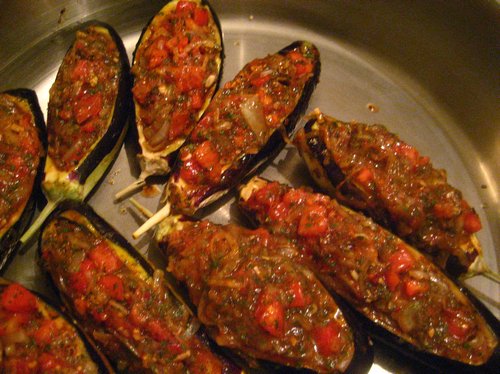
Imam Bayildi: The Imam Fainted

This fabled Turkish dish — made from eggplant, tomatoes, onions, herbs and spices — got its name from its effect on a certain cleric. Possibly from how amazing it tastes, possibly from seeing how much olive oil goes into making it.
IMG 3162

Eveline shows the class how to core and peel tomatoes (lookit how RED they are!). Classmate Simon puts some muscle into machete-ing the mint.
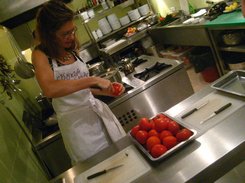
IMG 3115IMG 3126

Feyzi, Eveline’s talented and tireless chef, gives Babs a lesson in putting the squeeze on sliced onions, then dollops in tomato paste and red pepper paste. The latter is made in villages all over Turkey, by cooking red peppers then sun-drying them to concentrate the flavour. I’ll have to figure out where to buy this in whatever city we end up living in next.

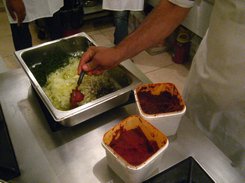
IMG 3120IMG 3140

Next, we make eggplant boats, stuff them silly, lay them in a steaming pan, and watch Feyzi lay on the olive oil…and then some, and then some. A few classmates start to feel faint…

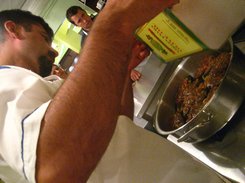
IMG 3156IMG 3165

One of the rare moments Babs bothers to photograph his food.

IMG 3240

Etli Yaprak Dolmasi: Grape Leaves Stuffed with Meat and Rice

I’ve never been a fan of dolmas until right now. I’ve wanted to like them, but there’s something about the taste that never went down well. It was just too…overpoweringly…green? Turns out, grape leaves are usually sold in brine, and the more usual way to eat them is cold. This particular dish washes the leaves and cooks them, which may explain the much mellower flavour of the leaf.

We sort the leaves by size, and fashion a stuffing of minced beef, lamb, rice, tomatoes, onions, garlic and herbs.

IMG 3192

Eveline shows us how to roll a dolma, which I turn out to be idiotically slow at. Those of you used to rolling ciggies are likely to do better. Apparently if you are a guest in a Turkish home, the smaller the dolmas, the more honour your host is showing you, since they went through all that extra faff to make them that dainty. I can just see Babs and myself protesting “Please please we’re all friends here! No need for such ceremony! Bigger is fine!”

We start a production line. Many hands make light work.

IMG 3196IMG 3198

Boil in stock, then serve with yoghurt on the side. Dolmalicious.

IMG 3242

Mantarli Sac Boregi: Anatolian Flatbread with Mushrooms and Herbs

The key to these tasty mushroom packets is the pillow casing, calledyufka. They remind me of popiah (Chinese spring roll) skin, but with more elasticity. Cut the yufka down to size, lay on the pre-pan-fried mushrooms and herbs, fold, and lightly pan-fry the packet on all sides. Restaurants are more likely to deep fry these, resulting in something more akin to samosas .

Other popular fillings among the locals include spinach or cheese. I expect if I get around to making these at home, I’ll be making them with shrooms AND spinach AND cheese.

IMG 3216IMG 3219

IMG 3230

IMG 3241

Yayla Corbasi: Meadow Soup

This hot yoghurt and mint soup turned out to be a great combination of refreshment (from the lightness of the yoghurt and mint and lemon) and comfort (from the meat stock). I’m looking forward to making more yoghurt-based soups at home, or maybe using them as a substitute for cream.
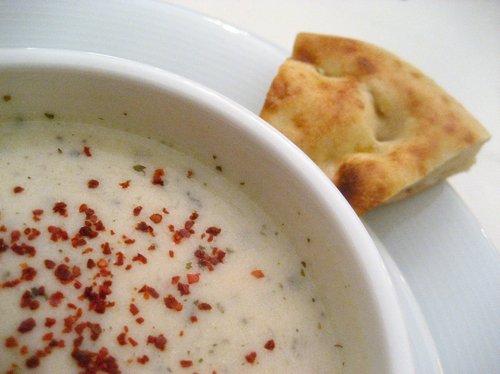
IMG 3238

Sekerpare: Syrupy Semolina Sponge Cakes with Hazelnuts

Another production line exercise in rolling out cookie-dough balls, plonking in the hazelnuts and brushing on the egg-white glaze before they go into the oven.

IMG 3174

My heart stops momentarily as Eveline drowns the baked cakes in sugar syrup. They are then left to sit in the syrup and soak it all in — at commecial bakeries possibly for a day or 2. I give my heart a few good thumps to jumpstart it.

IMG 3210

Dust with powdered pistachio and dessicated coconut. Thankfully, these tasted lighter than I thought they were going to. For all my protesting I scarf it all down, while some others at the table sensibly stop at 1.

IMG 3233

IMG 3247After lunch, we peruse Eveline’s little shop shelf, which offers items such as spices, home-made jam (right), ornate tea trays and even the lovely giant curved knife shown above. Try explaining that one to airport security.

The retired American couple pick up a tea tray, and Babs and I pick up a copy of Tales from the Expat Harem , a book chronicling the adventures and insights of 32 expat women from 4 continents now living in Turkey as archeologists, volunteers, artists and entrepreneurs etc.

Eveline’s chapter “The Painting or the Boy” is an engaging few pages that punch through rose-tinted glasses and pinch at the raw nerves of running a business in a foreign land and culture, and grappling with managing an employee with strong similarities in work ethic and conviction, but competely opposite beliefs. I look forward to reading the other stories, and the fruition of Eveline’s memoirs which she’s currently writing.

As for the class, it was a very enjoyable 4 hours of getting our hands saucy and then eating our handiwork. At a class size of 8, we just about fit into the teaching kitchen, so I’m not sure how well a full class size of 10 would navigate the space. It might be ok, if you’re closer to the size of the dolmas of a very hospitable Turkish host.

Eveline also runs afternoon classes than end with dinner. If you want to test her culinary credentials before signing up for the class, or just want to sample her work without learning how to cook it, her restaurant is open for lunch, and by appointment for dinner.

Cooking Alaturka
Akbiyik Caddesi 72A
Sultanahmet, Istanbul
+90 212 458 59 19

Still plowing through notes and photos from Central and Eastern Europe, but given it’s already halfway through Ramadan, I thought to skip forward briefly to the action in Istanbul.

Ramadan — or Ramazan, for the Turks — is the annual month-long fast for Muslims. Any eating or drinking is done sans sunlight. The most electric time of day this time of year, therefore, is just as the prayer call at dusk commences, signalling the break of the day’s fast. Food vendors and their customers — having been poised at the starting blocks — bound like coiled springs into a blur of lentil soups, mezzes and pides before digging into heavier meatier fare.

Restaurants all over town offer special Ramazan feast menus, but feeling fairly budget-battered after emerging from Russia, Babs and I mostly followed my street-urchin palette around town. I am delighted to say, Istanbul more than delivered.

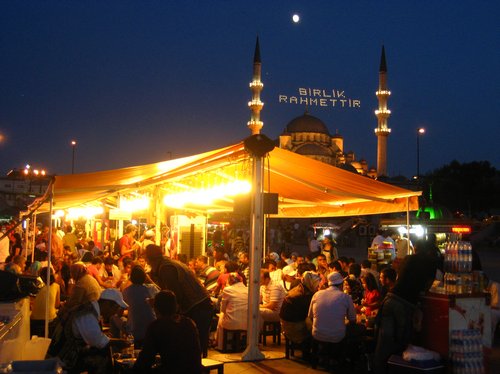
IMG 2443

Above: Evening breakfast by the fish sandwich boats at the Eminonu end of the Galata Bridge

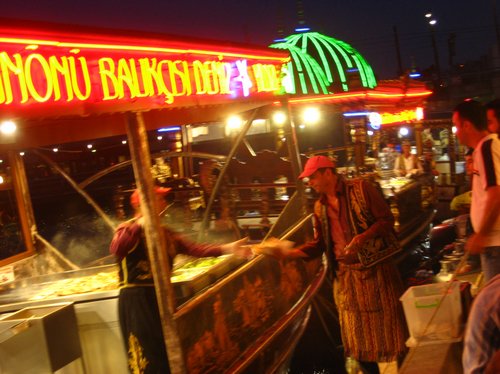
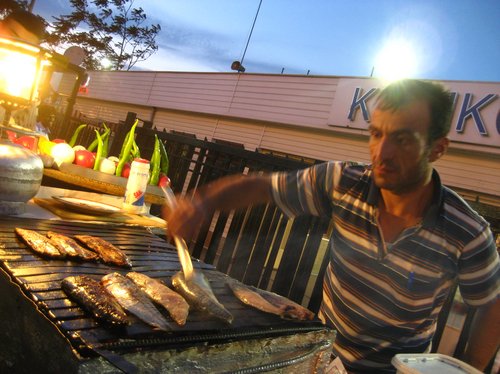
One of the most fun, overload-your-senses way to break-fast in Istanbul is to join the crowd under the fish sandwich tents, at the Eminonu end of the Galata Bridge. Mackeral fillets are fried en-masse on viciously bobbing boats a mere few inches from you (I felt sea-sick just trying to take this photo below).

IMG 2445

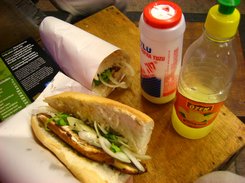
There’s salt and lemon juice at every table for you to jazz up your 4-lira sandwich, and plenty of colourful pickle carts nearby if you want a side dish.

IMG 2448IMG 2477

If you’re good to eat on your feet, however, look for the pushcart vendors just a few steps away. This gentleman’s mackeral fillets were thicker, had more bite (which means they were fresher), had that lovely irreplaceable smokiness of a charcoal flame, and cost only 3 lira.

IMG 2440

I am still slightly sore at Babs for scarfing more than his fair share of the sandwich we shared — he ruthlessly played the “you snooze you lose” card because I was running around snapping photos. Unfortunately, if tried by a jury of our peers, I know his defence would hold.

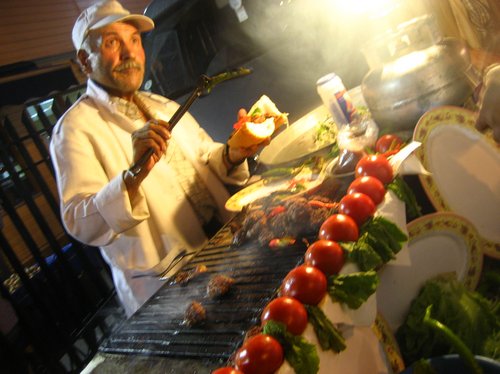
Only one way to remedy that. Move on to the kofte (spicy meatballs) sandwich cart a few steps on. Yes, I would like a toasted green chilli with that, please, Uncle. Absolutely gorgeous. And only 2 lira! Gawd I love this city.

IMG 2462

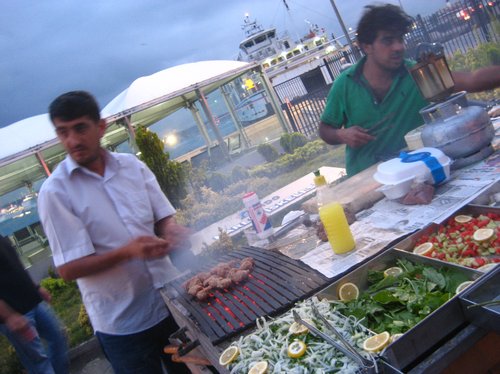
What’s this, what’s this? A 2-grill pushcart, one for fish and one for kofte! And a DIY salad bar to boot! I found these street-cuisine geniuses at Sirkeci, right outside the entrance to the ferry to the Harem bus station across the water.

IMG 3297

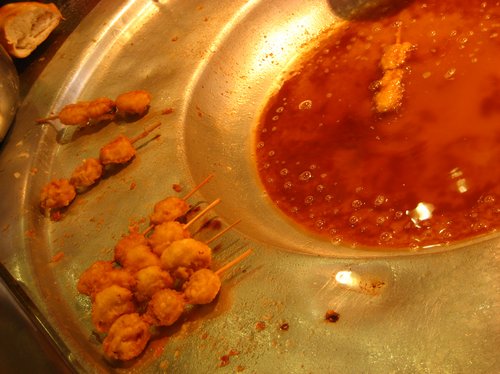
All that grilling and greens too healthy for you? How about some battered and deep fried mussels? Many touristy fish restaurants will have a mussel-stand for the casual passer-by. We found this one on Sahne Sokuk, just off Istikal Caddesi in Beyoglu.

IMG 2602

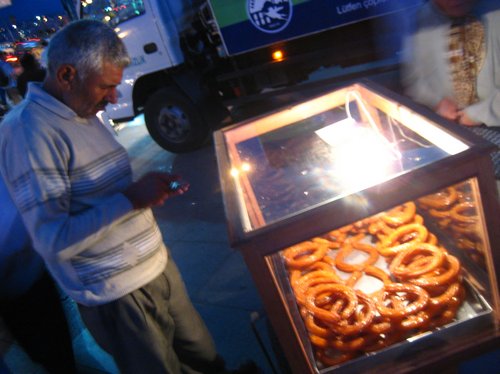
To end your break-fast stroll on a sweet note, grab some tulumba — deep fried dough drizzled (regularly, throughout the day… urk!) with sugar syrup. Sold as long pretzel-like rings, as below, and thumb-length stubs.

IMG 2560

Fast Breaking News: Free Dinner at Fast-Breaking Tents

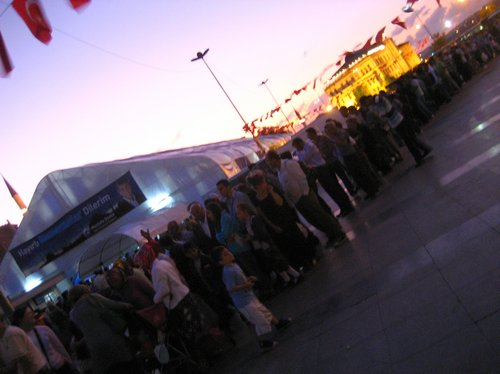
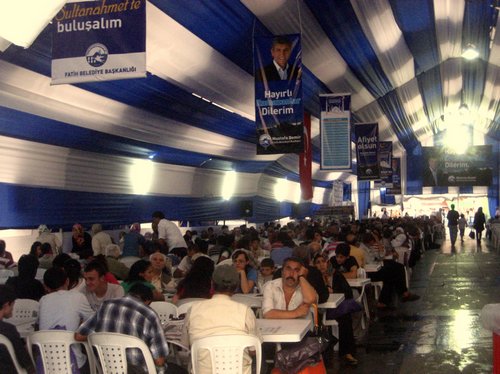
The most popular break-fast treat in town is evidently in one of the city’s many iftar (break-fast) tents, sponsored by local councils. The queues start some 2 hours before dusk, and according to a friendly security guard, this tent feeds about 1,500 people a day. City-wide, Istanbul hosts some 100 tents and according to Turkish English-language newspaper TodaysZaman expects to feed some 300,000 people this Ramazan at the cost of US$15m.

IMG 2559


In principle the iftar tents are meant to provide food for the poor and those who are not able to prepare dinner at home because of work — in Islam it’s considered a good deed to feed those who have been fasting. It seems plenty of locals join in simply for the festive community atmosphere. We also saw a few tourists in line. In the end we decided we couldn’t join in in good conscience — our budget wasn’t that battered, we’re not local taxpayers, and I haven’t even been fasting — but the friendly security guard lets me poke my head in to take this photo.

IMG 3257

Hayirli Ramazanlar, folks. Going hungry — especially on a voluntary basis — has never been a strong point with this particular foodie, so may God look very kindly on you.

Riding in Göreme

Well, we’re now in Turkey, soon to travel to Syria, and I realise it’s been a while since I wrote my own post for the blog. Well, I’m not about to catch up with this one, but thought I’d skip forward with a photo from Göreme, in the Cappadocia region of Turkey.
Wabs riding horses around the moonscape of Cappadocia
Have a look at the bizarre ‘fairy chimney’ structures in the background. They’re all around the town we’re staying in, and most were hollowed out and made into houses hundreds of years ago. It’s quite surreal. The Göreme open air museum showcases a set of thousand year old churches hollowed out of these fairy chimneys and the surrounding cliffs.

Babs and I spent 1 night in Zagreb at the start of August, as a transit point between Dubrovnik and Prague. We spent 1 day exploring Upper Town — made up of the historical clerical distrct called Kaptol, and the merchant and tradesman stronghold called Gradec — and the next day wandering the parks and government monuments of Lower Town.

Smack in the middle of it all, up the steps from Ban Jelacic Square, was my favourite part of the city — Dolac Market, where we bought and made lunch on both days for less than €4 per person.

IMG 0745

IMG 0812Dolac Market was built between 1926 and 1930, when city authorities decided to level an inner city slum and replace it with a destination more palatable to visitors’ eyes. The market is currently open from 6am – 2pm each day, and until 3pm on Saturdays.
Its centrepiece is an armada of red-and-white striped umbrellas sheltering fruit, vegetable and local craft vendors. On the far side of the square is a stairway and elevator that leads you down to 2 covered storeys of meat and cheese vendors.

The market square is ringed with cafes and bars, where you can perch and watch the grazing and haggling action, or better yet, grab a borek (cheese, spinach or meat-stuffed filo) and kava to line your stomach and clear your head sufficiently, then wade into the thick of it yourself.

We did just fall off the overnight bus from Dubrovnik, but geez, the old women around here look like they’re made pretty much of the same stuff as the statue above. So, bleary-eyed schmleary-eyed! Stiff upper lip, chug another double expresso, and in we go…

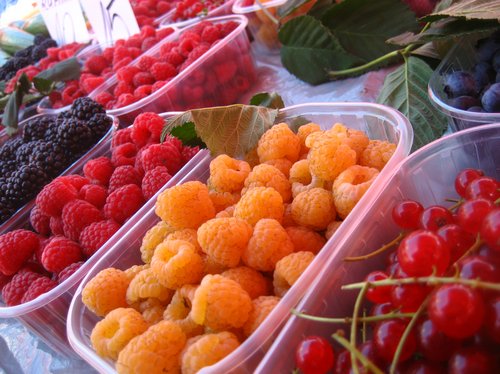
Turns out, the kaleiscope of colours will jolt you awake anyway. Given it was the height of summer at the the time, there was an explosion of berries. A new find for me were these pretty yellow raspberries.

IMG 0755

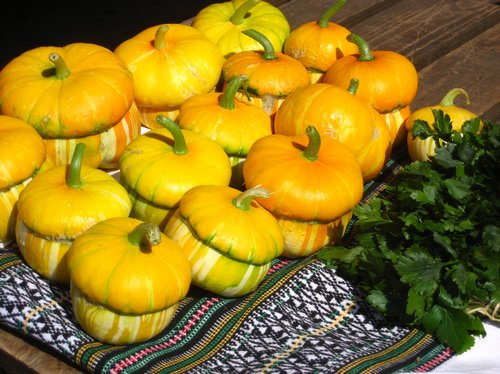
I’d seen curiously shaped pettipans in UK farmers markets before, but never ones of this muffin shape. Anyone know if they grow this way naturally, or if they are forced into this shape? (A long time ago as a cub reporter I covered a story on the Japanese growing cube-shaped watermelons in a bid for easier transport. Each baby watermelon would be placed in a box, and the box would be replaced with a larger one as the melon grew. I don’t get the sense the idea caught on, given the amount of faff required.)

IMG 0758

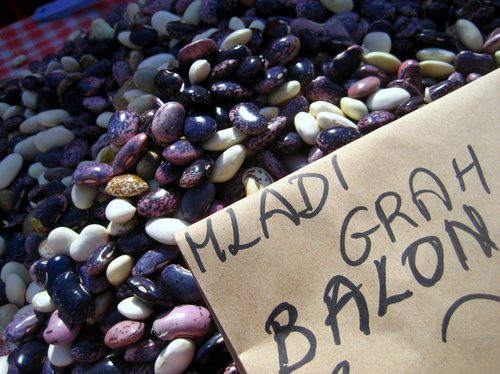
Another first for me — these gorgeous beans of varying shades and speckles of purple, freshly shelled by stallholders. You’d think they were jellybellys!

IMG 0748

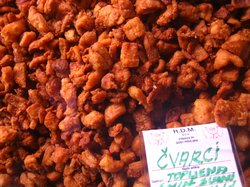
IMG 0786 On to the indoor meat section one floor below. I felt my arteries clog just at the sight of this shelf full of pork crackling (this photo’s for you Jas!)
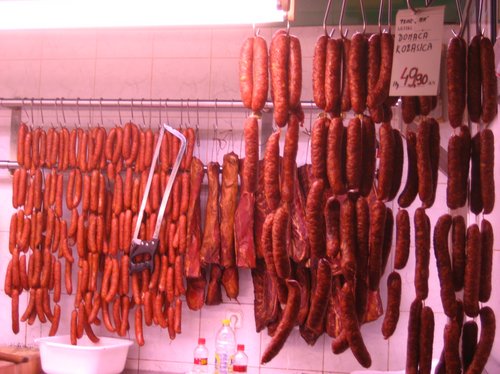
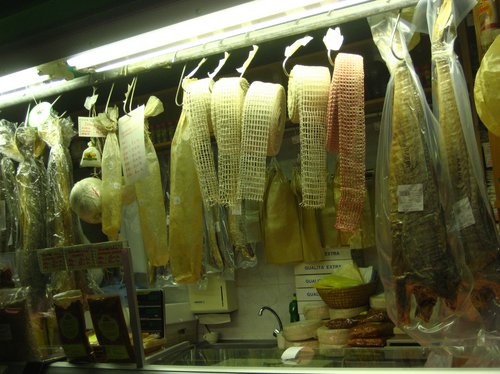
There were smoked meats and sausages everywhere, from different animals, using different spice blends, from different makers and regions.

And just in case you had a hankering for something different from all that was on offer, there was a stall that sold sausage casings and nettings for you to make your own at home.

IMG 0766IMG 0767

And now to the cheese wing. If you hear a lot of “Sir” this and “Sir” that around here, it’s not that these vendors are extra formal. Sir is the local word for cheese. The local make seems to be a mild, salty and sometimes curdy cross between ricotta and mozzerella, made simply in plastic bowls. Some had been smoked for a stronger taste. I was especially amused by the cheese cones. Sadly, these were mostly targeted at local home-based buyers and we weren’t able to buy a small tourist-sized portion (or maybe we just lost too much in translation…).

We got a good taste of the goods however, as many stallholders were keen to show off their wares and give us a sample to nibble on. Hvala ti, ladies!

IMG 0782

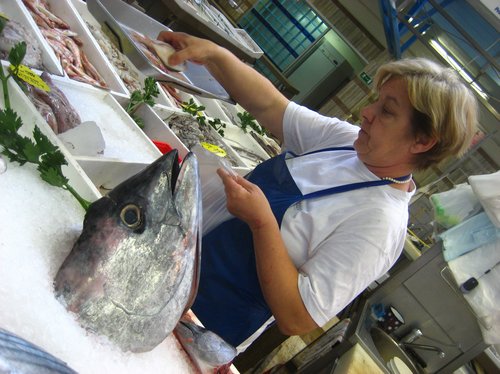
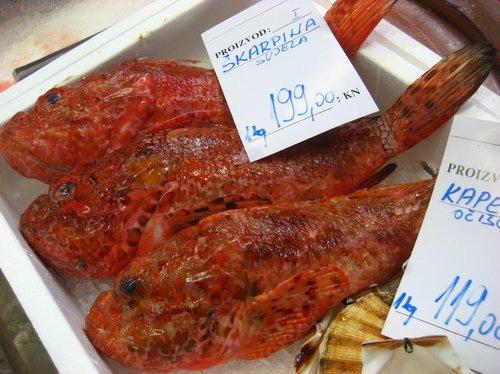
The fishmongers had their own off-shoot building. The range wasn’t anything to scream about, but I was amused by this helmet-sized tuna head. Also, we saw some of the skarpina we had at Restaurant Lindo in Dubrovnik, in their original state. Very pretty.

IMG 0839IMG 0837

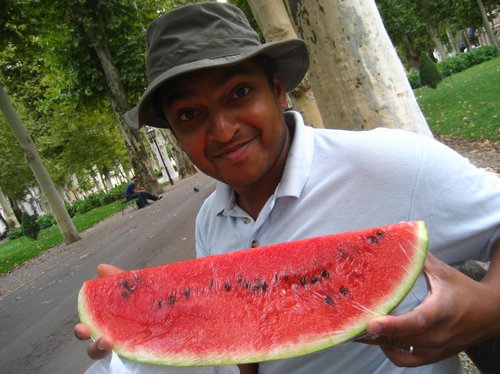
On top of providing hours of entertainment, local markets are a great way to very eat well on a tight budget. We could barely eat or drink anything else after this 1.5kg slice of watermelon, bought for ~€1. The plums and blueberries would have to wait, but there might just be enough room for that half of a rotisserie chicken…

IMG 0842

Sometimes I imagine what hell might be like. Firstly, I imagine it’s customised, so that eternal suffering is maximised for each person. In one of my many imagined versions, it’s always mid January in Eastern Europe (yes in this version I suppose hell freezes over). And the Soup Nazi from Seinfeld (or a real Nazi, given the location and history dialed to the right year) bellows at me “NO SOUP FOR YOU!” unto all eternity.

*Shudder*

It’s enough to make me behave. And slurp as much soup as I can as summer winds down in Eastern Europe. I wanted to share with you my most souperb finds. The Berlin film scene has its Golden Bears; I thought I might hand out a few Golden Bowls. If you have nominees to add, I’d love to hear from you!

For Best Ensemble Performance of a Soup Menu, the Golden Bowl goes to Restaurant Zemaiciai in Vilnius, Lithuania. The richness of their soup stock blew me away, be it the very dramatic borscht with rib, sorrel soup with smoked meat and quail’s egg, or the humble but powerfully executed potato soup. This kind of deep sweetness in a stock you can only get from a lot of lovely bones, and time. Cheating by using MSG tends to leave a hollow after-tinge. Good stock is not hard to make, but many restaurants don’t have that kind of patience.

IMG 1528IMG 1530

For Best Art Direction, the Golden Bowl goes to organic restaurant AED in Tallinn, Estonia. Kudos for keeping this cute island of summer sprouts so pristine amid a red sea of beetroot.

IMG 1914

IMG 1242 For Best Performance Featuring a seasonal ingredient, the Golden Bowl goes to the mushroom soup at U Babci Maliny in Krakow, Poland.
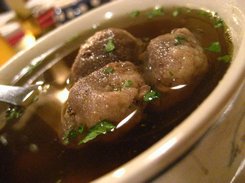
Very ballsy with the boletus, and brought out in a giant bread basket to boot!

And now for a few special mentions.

For successfully making me miss every Jewish mother who ever had me at their dinner table while I was a student at Brandeis, the 2 winners are both from Krakow (natch).

CK Dezerter’s beef buillion with liver balls; and U Babci Maliny’s borscht with dumplings. Special congratulations to the latter for living up to its name — Babci Maliny means Grandma Raspberry (and she has the colour on all her walls to prove it) Maseltov!

IMG 1322IMG 1240

And last but not least, for a very special booby “Surprise Supplies” prize (say that 3 times fast), the Golden Bowl goes to the hot and sour soup by Chinese restaurant CBET BOCTOKA in St Petersburg, Russia.

My heart sank when they brought this bowl below to our table. It sure didn’t look hot or sour. And it was a lot larger than the 2 small portions we ordered. Were we going to get charged for an order completely lost in translation?

IMG 2131

Turns out, it WAS hot and sour soup, just not the usual gloopy orange Szechuan kind. And very delish at that! Surprise!

And yes, they didn’t charge us for 2 portions. They charged us LESS. Babs and I counted the portions we had from the bowl below. We counted 6. Supplies!

The perfect tonic for being caught in the rain earlier in the day. And it made me feel souper smug for ordering our food in Chinese.

Zemaiciai
Vokieciu gatve 24
Senamiestis, Vilnius, 01013, Lithuania
+370 5 2616573

Restaurant AED (Embassy of Pure Food)
Rataskaevu 8
10123 Tallinn, Estonia
+372 626 9088

U Babci Maliny
Ul. Szpitlana 38
Krakow, Poland
+48 12 421 4818
(Note: Most guidebooks — even the restaurants own website — still show a Slawkowska 17 address, but this location has closed. Thanks to the kindly building security guard who sent me on to the Szpitlana location)

CK Dezerter
Braka 6
Krakow 31005, Poland
+48 12 422 7931

CBET BOCTOKA
2nd Sovetskaya 12
St Petersburg, Russia
+7 812 717 2511

Am awash in notes and photos from Dubrovnik, Zagreb and Prague, but it turns out my chica and fellow food dork kopibren is dropping into Berlin at month’s end. So, wurst things wurst…

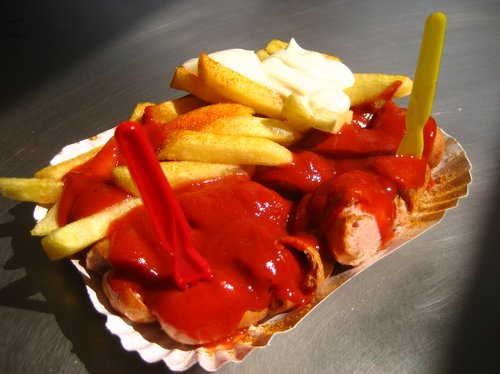
Check in, chuck your bags, and charge over to the Curry 36 stand in Western Kreuszberg for potentially the best of the (curry)wurst in town — grilled sausages sliced and drenched in ketchup and mayo and sprinkled with a mild chili powder. Death by drowning in this dip would not be a dishonourable one, methinks.

1 sausage with sauce cost €1.50 and 2 sausages with fries (below) cost less than €5.

IMG 1125IMG 1123

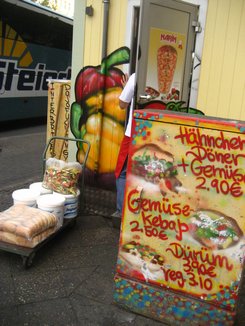
But be sure to show up hungry (or like me, greedy), or with friends, so that you can ALSO partake of Mustafas kebabs just a few steps away from Curry 36. The kebab stand will be hard to miss. The painted cable box greets you as you exit Mehringdamm station, as does the largest barrel of grilling kebab meat I have ever seen. The kebab itself will be hard to fit in your mouth, stuffed as it is with salad, roast veggies and feta. Again, this cost less than €5.

IMG 1193IMG 1118IMG 1131

Given their great bite-for-buck, I was tempted to simply spend all our meals in Berlin cruising wurst and kebab stands in each neighbourhood. Temptation came in all sorts of contraptions! E.g., a strap-on hot dog stand, and another fashioned from a converted wheelchair. Berlin’s creativity at its wurst.

IMG 1039IMG 1166

IMG 1026But that kind of kebab-crawl would likely require a lot more late-night clubbing than we had time or money more. So in our short stay we sampled only Tresor, a converted power station basement down the street from Hotel A&O Mitte where we were staying. The house music even at 4am wasn’t as hardcore as the uber-bunker setting (Guess I should’ve gotten off my ass and headed to Panorama, a recommendation from my music and nightlife expert pal Mogs).
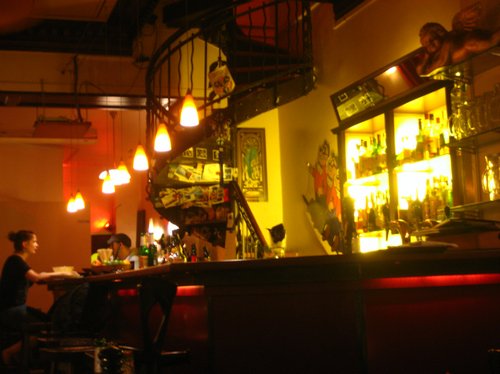
I was quite amused by Tresor’s doorbitch, though. And I quote: “Your sandals are a problem for the club…if you fall down the stairs it’s your problem”.

We’re not in London Zone 1 anymore, Toto.

Also tempting was Sage Club (down the street from Tresor), but Babs and I had dresscode problems there as well. Namely, we didn’t have any leather or PVC. So we boogied outside on the street corner where the music was pumping out of a building vent… with kebabs of course.

We took in a more genteel side of the city the next evening. Fellas was a cute bistro in the recently posh Prenzlauer Berg, which served giant and well made salads along with other classic continental offerings.

IMG 1073

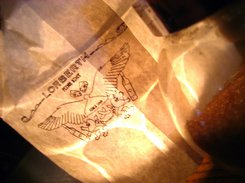
On a walking tour of “lofts-for sale” buildings in the neighbourhood after dinner, we chanced upon the very charming Lorberth cafe, which offered a range of organic desserts, coffees and teas (the latter served in large bowls). We settled on the delectable and none-too-sweet “old fashioned German blueberry cake”. I was quite taken with their shabby-chic lampshade — a paper bag stamped with their logo and placed over a candle in a glass.

IMG 1081IMG 1084

Wall to Wall Sightseeing

I realised only afterwards that the inedible part of my tour of Berlin centred around a “wall” theme.
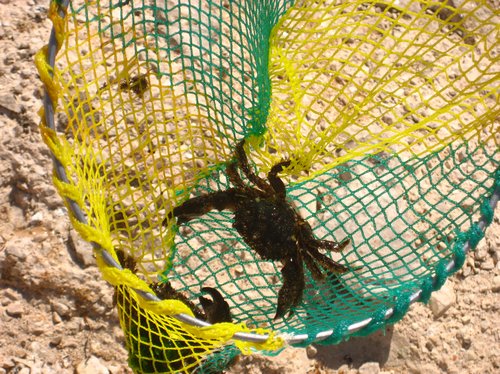
2009 being the 20th anniversary of the fall of the Berlin Wall, Alexanderplatz had a magnificent exhibition on the history of the wall, the long-running opposition against it and the events leading up to its eventual fall.

IMG 1037

At both the Jewish Museum and the Holocaust Memorial, the walls of the structure housed exhibits but also were exhibits in their own right.

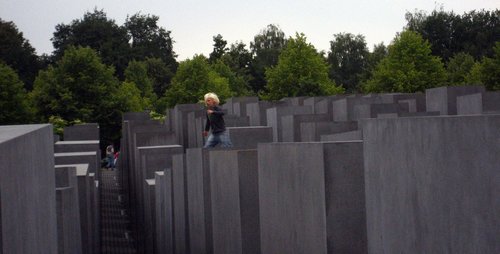
As Babs and I wandered around the forest of concrete blocks at the Holocaust Memorial (think an abstract representation of a cemetary) for example, we watched this kid below scamper back and forth across the block-tops. He’d cross our path from above every so often. A minute or 2 later an angry security guard would chase from behind from the ground below.

A few members of another group would race ahead of their friends, duck behind a block, and turn on them as they approached and “gun them down” like one of those 1st-person shoot-em-up games.

Curious. Chilling. Maybe too telling.

IMG 1184

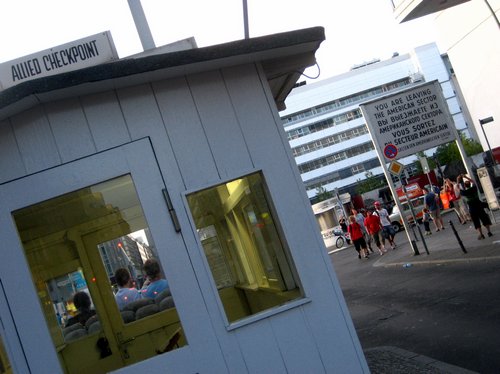
For my Cold-War-spy-novel fan Dad, I went to pay my respects at Checkpoint Charlie, the point of transit between the old West and East Berlin for many an emissary of espionage. The only walls here now are the ones going up on vast construction sites. The reconconstruction of the checkpoint itself looked sadly a tad kitschy — the 2nd photo below is more telling of how history played out.

IMG 1063IMG 1059

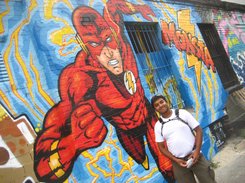
Most of what is left of the Berlin Wall itself is now better known as the East Side Gallery, a series of murals along the river Spree, now dotted with cafes, restaurants, and river tourboats. Various artists — some new and some returning from their original murals right after 1989 — are being commissioned to repaint sections of the wall.

IMG 1156IMG 1158IMG 1145

There are tons of walking and biking tours you can do in Berlin, depending on your niche interest, be it history, pub-crawling or even exploring underground tunnel systems. We signed up for the Alternative Berlin walking tour, and got a fabulous 5-hour introduction to the city’s best known street artists and popular street culture hangouts. The tour meets under the TV tower at Alexanderplatz at 11am and 1pm daily, and takes tips rather than charges a fee.

IMG 1089IMG 1134IMG 1086IMG 1114

IMG 1094IMG 1101

Above: Tacheles (meaning Straight Talk in Yiddish), the landmark artist squatter colony, is worth visiting as soon as possible, as it’s currently fighting an eviction notice from building owner Fundus, an investment fund that’s keen to build luxury apartments on the site (Related news story here). Right now, goodness knows why, really. As it is, Berlin is a city of ~4 million people but the city has space and infrastructure for 8 million. And there’s that little detail of global financing still being in the toilet. Anyway, those among you who feel strongly can sign a petition against the eviction notice onsite.

Overall, I can’t believe that it took me this long to get Berlin on my radar screen (evidence that I was never built to be one of the cool kids, really). So much history, so much new energy, and possibly most importantly, just so much space for all of it to keep growing without falling all over each other.

But to those who haven’t been or who have been long missing: Go now. Go soon. Because, really, new walls are coming up. And eventually the time will come, when they can be accessed only via checkbook charlie.

Curry 36 (and Mustafas kebabs)
Mehringdamm 36
10961 Kreuzberg, Berlin, Germany
+49 30 2517368

Fellas
Stargarder Straße 3
10437 Prenzlauer Berg
Berlin, Germany
+49 030 46796314

Lorberth
Pappelallee 77,
10437 Prenzlauer Berg
Berlin, Germany
+49 30 26349330

A few of my favourite fellow food dorks and I recently started an annual summer tradition I like to call “Melfi Mayhem”. Using our friend Melf’s birthday as a launchpad, we’d pick an idyllic location to eat, drink and be very very merry. The inaugural party in 2008 was on The Almalfi Coast in Italy, and this year we pounded the pintxos bars in San Sebastian in the north-east corner of Spain. We may have to take a meaty meander to Buenos Aires next year, but I have officially submitted Dubrovnik as a location candidate for 2011.

The pitch: Sapphire blue waters for swimming (still with various types of fish to keep you company no less, so go while you can), vermillion sunsets, an on-the-ball but chilled out service culture, and quite the formidable edible Adriatic aquarium, at reasonable prices.

IMG 0634IMG 0646IMG 0514

Here are 3 fine fishy finds from the recce trip.
Konoba Lokanda Peskarija

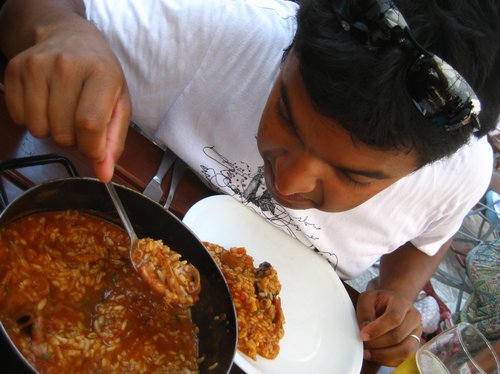
This was a great first stop in Dubrovnik, thanks to the advice of our fabulous hostess at Rooms Olga. Located at the old fish market harbour, Konoba Lokanda Peskarija won us over with big pots of fresh local product at fair prices. Below, I play peekaboo with mussels while Babs parses out the risotto. The style of the risotto is more reminiscent of Portugal than Italian risotto or Spanish paella. Apparently the risotto ala terroir is the squid ink kind; I didn’t order it only because I find the stuff really addictive and could end up eating it at every meal for our remaining 4 days (like I did on previous occasions in Barcelona and Venice).
IMG 0468IMG 0469

Orsan

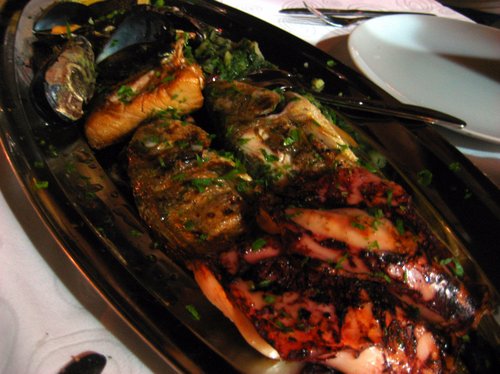
You can dine at the water’s edge (literally) at Orsan, located at Dubrovnik’s local yacht club, another recommendation from the owners of Rooms Olga. The octopus salad was beautifully crunchy, unlike the soggy and slightly powdery renditions in too many London locations. After hemming and hawing over mains, Babs and I embraced our indecision and got the seafood platter, with roasted squid, 2 kinds of fish and mussels. Oh for the days of a yuppy budget. Ah well. Sandwiches and fruit for lunch tomorrow it is, then.

IMG 0532IMG 0522IMG 0524

Restaurant Lindo

Between getting a very late start and then getting off at the wrong bus stop — which meant walking for another 30 minutes slightly uphill in the hot and muggy afternoon heat — we got to Restaurant Lindo at the fairly awkward hour of 3.30pm for lunch. Their hospitality was as old school as their Croatian menu, thankfully.

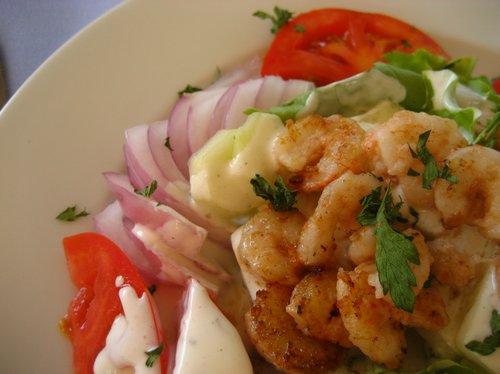
The fish soup was simple but strong, and Babs is keen to replicate their home-made bread. Very unfortunately because we were between meal shifts I didn’t get to try their slow roast meats (kept in a heavy iron pot and covered in hot ash on an open fire) as those need to be ordered in advance, but I was sufficiently placated by the house-special salad of tomatoes (at the height of their season in town judging by everyone’s garden patches), cucumbers, onion, shrimp and a light yoghurt dressing. Think Indian raita pimped up with shrimp. I’ll need to try making this when I have kitchen access again.

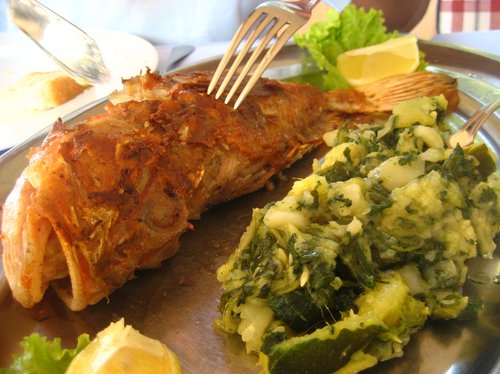
IMG 0535IMG 0536IMG 0538

The waiter offers to fillet our grilled scorpion fish for us. We can’t shoo him away fast enough. On the right is swiss chard cooked with potato, a popular local stodge-&-greens-in-one side dish.

IMG 0541

After lunch, a little jaunt in a laser. I sit up front, clinging to the mast like Odysseus before sailing into siren-land. We scheme about coming back here sooner rather than later. Next time, up and around the Dalmation islands. With a bigger boat. And friends.

IMG 0714

Konoba Lokanda Peskarija
Gorica Sv. Vlaha 77
20000 Dubrovnik, Croatia
+385 20 324747

(Couldn’t get Gmap to pintpoint well, but this is easy to find. Just ask locals for the old fishmarket harbour, where the tour boats to the islands come and go)
Orsan
Ivana Zajca 2 (at the yacht club)
20000 Dubrovnik, Croatia
+385 20 435 933
Restaurant Lindo
Iva Dulcica 39, Babin Kuk
20000 Dubrovnik, Croatia
+385 20 448 351

(Follow directions to the President hotel resort. The restaurant is part of the accompanying low-rise retail complex)

A Bari Delightful Day

IMG 0422

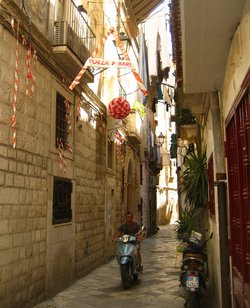
Maybe it’s true that everything’s better if you have no expectations. Or maybe we were so stressed out by Rome that the return to the charm of a less built up part of Italy was especially keenly felt. In any case, the 15 or so hours spent in the Adriatic port town of Bari — our transit point between an overnight train from Rome and an overnight ferry to Dubrovnik — were quite delightful.

Not that I could claim to know it beforehand, but Bari is the capital of the Puglia region and is the 2nd largest city after Naples in Southern Italy. In addition to fishing and trade, the city seems to thrive on a large grid of swank shopping boulevards.

Historically known as the exit doors of Italy where locals and visitors board boats for Greece and Croatia (as we did), the local government has been working hard to promote Bari as a destination in itself. Each September, for example, the city hosts the massive Fiera del Levante trade and industry fair. My ever-hip friend Goz also sent an alert about the avant garde Fame art festival in Grottaglie — an hour southeast of Bari — opening in mid September this year (2009).

With much less ambition and agenda, we had breakfast at 8am at a cafe near the train station, and watched with bleary eyes the locals coming and going as they grabbed coffee and pastries on their way to work.

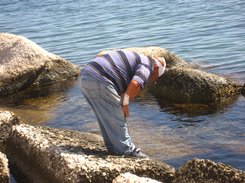
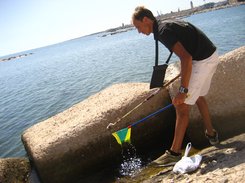
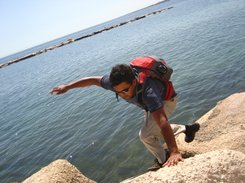
After, we decided to walk along the coastline in a bid to recce the port. Others also soaking in the morning light included clumps of heroically pot-bellied old men (talking and gesticulating at each other in that classically dramatic Italian fashion), and locals hunting among the sea-wall rocks for little fish and crabs. The man on the right proudly showed me his catch.

IMG 0436IMG 0428IMG 0429

Babs joins in on some crab-hunting action with his camera.

IMG 0431IMG 0432

I’m not a morning person, but if there’s one thing I do like about having time to kill in the early hours of the day, it’s checking out and dawdling at local markets, like the one at the entrance of Bari Vecchia, Bari’s medieval old town.

IMG 0416

Right across from the market we chanced upon Osteria Con Cucina, a subterranean dining room where we had a scrumptious 4-course lunch and coffee. There was no menu — the owner just listed a few options for the primi and secondi courses. And there was no option to have only 1 course, as some tourists a few tables away tried to do. Each meal, no matter what you picked, came to €20 per person. This is more like the Italy I know and love!
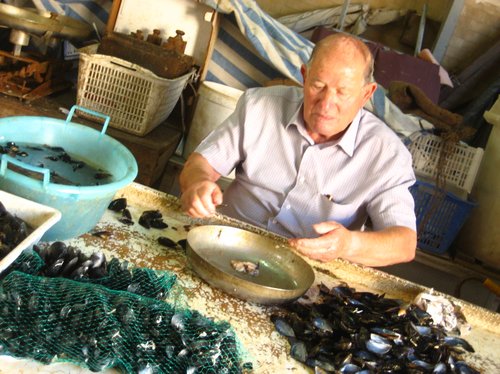
Even more entertaining was sneaking glances at the big black suited Italian dude at the table next to us, reading the sports pages of the local paper. He scarfed down a platter of raw mussels, then a large plate of seafood linguine. Evidently he had access to a special menu, perhaps one reserved for non-tourists, or regulars, or members of the family, or members of the other family.

After Mr Big Black Suit was done he strode into the kitchen to chat with the chef, then to the bar to chat with the owner (I craned my neck but couldn’t see round the pillar to check if he paid like everyone else) before leaving.

Ah well. Back to lunch.

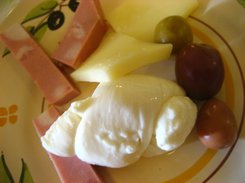
Antipasti: Toasted bread rubbed with olive oil and tomato, with rocket and new potatoes; Bits of ham, olives and 2 types of cheese.

IMG 0437IMG 0439

Primi: Bari’s most famous dish (and rightly so), riso, patate e cozze (rice, potatoes and mussels) with everything cooked (baked?) in a briny stock. I’ll need to try and make this sometime. Below: A very well made pasta with seafood, with clams, mussels, shrimp and squid.

IMG 0441

IMG 0443

Secondi: Roasted octopus, entirely intact. The waiter chuckled at how gleeful I was looking.

IMG 0448

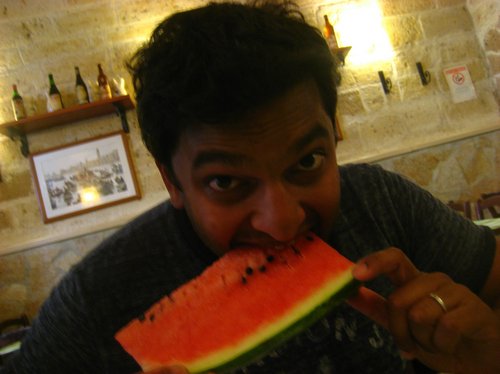
Dolci: Chilled watermelon — a godsend for a scorching summer day.

IMG 0450

The rest of the day was spent reading on park benches, walking around the town’s old castles and churches (Wikipedia provides a good list with descriptions in its “Main Sights” section), searching in vain for an internet cafe, and even setting off on an eventually unsuccessful expedition to use the showers at the municipal swimming pool.

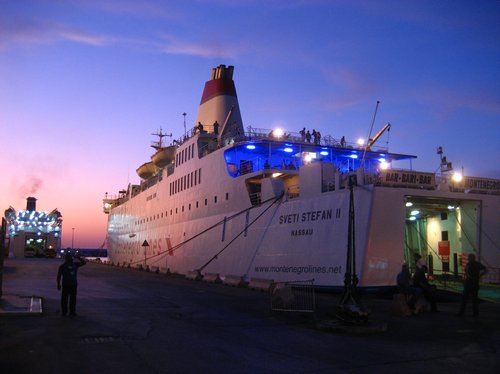
Eventually it came time to board our overnight ferry to Dubrovnik, where we again bought deck seats instead of bunks.

IMG 0454

We settled in for the night on a couple of wooden benches on the outdoor deck under the stars, using our daypacks as pillows. We were sweaty and sticky, on the 2nd night in a row sleeping on the move. Usually I’d be in a slightly psychotic state by now, but I was still floating on the memory of a very delicious lunch.

It would seem that a little well-cooked pulpo can go a bari long way.

Osteria con Cucina
Strada Vallisa, 23
Bari, Italy

IMG 0308

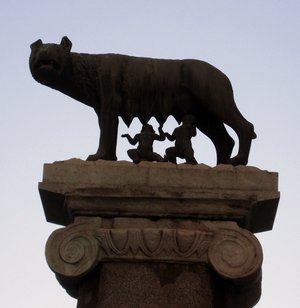
Prologue: The iconic symbol of the birth of Rome involves feeding — mythological founders Romulus and Remus were raised by wolves, literally. Romulus later kills his twin brother to consolidate his dominion over the city.

Just before we left Andalucia, we bought a tin of sardines, a tin of scallops and a tin of razor clams. They were to be opened during emergenices only.

We opened the first tin in Rome.

We were placed in a B&B room near Rome Termini train station, different from the one we booked. This one had a bathroom you could barely turn around in, and a giant hole in the wall where the A/C vent was supposed to be. Cue hot air and noise from the street all night.

The only things we could see available for the catered breakfast were packets of croissants, which had a 2011 expiry date. I really don’t want to know what the pastry was inundated with to give that kind of shelf life.
We knew Rome was going to be expensive, but was this really all that €50 a night was going to get us?

Perhaps not.

The next morning, the Chinese lady at front desk, upon realising that I spoke Mandarin (she had no English and I had no Italian) started ranting about how our inkeeper was “bullying” us. Apparently our original room had a damaged door — which by this morning had been fixed — so we should really get on the innkeeper’s case and demand to be moved to our original room, instead of putting up with the tiny room that her B&B didn’t even deign to rent out, but rather used only for staff to rest in during the day.

And so, in the heart of the Roman empire, counsel from the Chinese empire got us into the room we originally booked. Which, as it turns out, sleeps 3 people more than comfortably, and a kitchen full of toast, sausages, cheese, preserves and drinks for breakfast.

This happening upon our arrival in Rome sadly soured my view of the eternal city for our remaining time there. I couldn’t quite shake the feeling that there was always a little something that the Romans were holding out on us. A little more on the plate. A little more information. Heck, in Julius Caesar’s case, a little dagger behind the cloak.

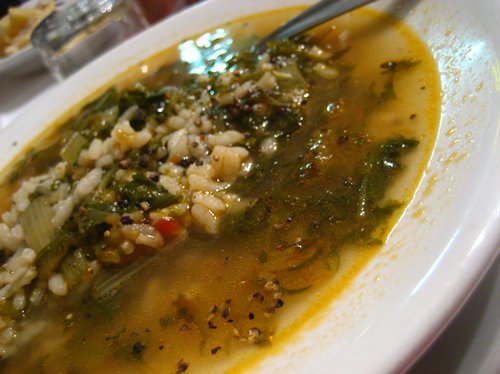
In the case of Trattoria Da Gino, a well known establishment next to the Parlianment Building frequented by politicians and journalists, it was the the minestrone I actually ordered (ie, with pasta, rather than rice). Otherwise, the lamb and osso bucco were decent bite-for-buck.

IMG 0405IMG 0410IMG 0413

And, taking the cake, the waiter at L’Angoletto di Musei a few streets from the Vatican didn’t bother to hint at what I was getting when I ordered “Angelo’s special pasta”. Ok, so Babs and I laughed ourselves silly once I got past the initial shock. But it goes to show.

IMG 0340

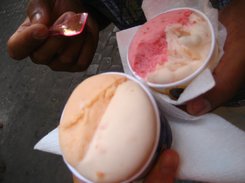
What probably saved my blood from boiling over (figuratively and literally, given the sweltering 35 deg C afternoon heat) was Rome’s gelaterias. San Crispino is the hailed by the mainstream media as the Don of the genre in town, but my favourite (and the only real rave I have for Rome in this post) was Gelateria del Teatro, a tiny but rocketing up-and-comer with a mind-blowing watermelon granita. That unmistakeable chilled-ripe-watermelon scent of chlorophyll with a just a tinge of nectar is what I imagine rain in heaven will smell like. Stefano and Silvia, the husband-and-wife team that run the joint, use only natural and seasonal ingredients, sometimes hauled in by Stefano himself from the market on bicycle. All gelato is made in small batches onsite, and you won’t get any hassle if you poke your head in the back to see what’s in progress.

IMG 0387IMG 0355

Above: Babs and I both go for grapefruit sorbet at San Crispino, I balance it out with melon while Babs tarts it up further with raspberry; A cup of watermelon heaven from Gelateria del Teatro

Right now, that watermelon granita might the only reason I would go back to Rome. Otherwise, it just felt like the city was using its ancient and religious sites to milk visitors, without much ongoing investment into striving to provide value for money or excellence in hospitality. Resting on its laurels, as it were.

Trattoria Da Gino
Vicolo Rosini 4
Rome 00186, Italy
+39 06 6873434

L’Angoletto ai Musei
Via Leone IV, 2A
Rome 00192, Italy
+39 06 39723187

Il Gelato de San Crispino
Via Panetteria 42
Rome Italy

Gelateria del Teatro
Via di San Simone 70
Rome 00186, Italy
+39 06 45474880