Feeds:
Posts
Comments

Archive for the ‘Reportage’ Category

Souperb Finds in Eastern Europe

Sometimes I imagine what hell might be like. Firstly, I imagine it’s customised, so that eternal suffering is maximised for each person. In one of my many imagined versions, it’s always mid January in Eastern Europe (yes in this version I suppose hell freezes over). And the Soup Nazi from Seinfeld (or a real Nazi, given the location and history dialed to the right year) bellows at me “NO SOUP FOR YOU!” unto all eternity.

*Shudder*

It’s enough to make me behave. And slurp as much soup as I can as summer winds down in Eastern Europe. I wanted to share with you my most souperb finds. The Berlin film scene has its Golden Bears; I thought I might hand out a few Golden Bowls. If you have nominees to add, I’d love to hear from you!

For Best Ensemble Performance of a Soup Menu, the Golden Bowl goes to Restaurant Zemaiciai in Vilnius, Lithuania. The richness of their soup stock blew me away, be it the very dramatic borscht with rib, sorrel soup with smoked meat and quail’s egg, or the humble but powerfully executed potato soup. This kind of deep sweetness in a stock you can only get from a lot of lovely bones, and time. Cheating by using MSG tends to leave a hollow after-tinge. Good stock is not hard to make, but many restaurants don’t have that kind of patience.
IMG 1528IMG 1530

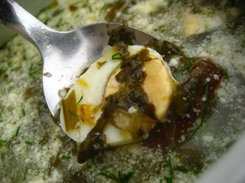
For Best Art Direction, the Golden Bowl goes to organic restaurant AED in Tallinn, Estonia. Kudos for keeping this cute island of summer sprouts so pristine amid a red sea of beetroot.

IMG 1914

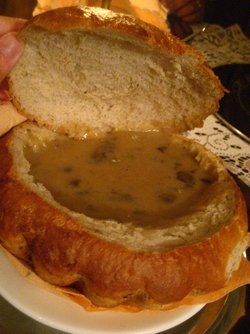
IMG 1242 For Best Performance Featuring a seasonal ingredient, the Golden Bowl goes to the mushroom soup at U Babci Maliny in Krakow, Poland.

Very ballsy with the boletus, and brought out in a giant bread basket to boot!

And now for a few special mentions.

For successfully making me miss every Jewish mother who ever had me at their dinner table while I was a student at Brandeis, the 2 winners are both from Krakow (natch).

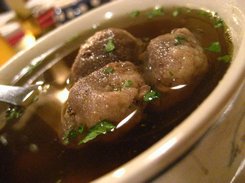
CK Dezerter’s beef buillion with liver balls; and U Babci Maliny’s borscht with dumplings. Special congratulations to the latter for living up to its name — Babci Maliny means Grandma Raspberry (and she has the colour on all her walls to prove it) Maseltov!
IMG 1322IMG 1240

And last but not least, for a very special booby “Surprise Supplies” prize (say that 3 times fast), the Golden Bowl goes to the hot and sour soup by Chinese restaurant CBET BOCTOKA in St Petersburg, Russia.

My heart sank when they brought this bowl below to our table. It sure didn’t look hot or sour. And it was a lot larger than the 2 small portions we ordered. Were we going to get charged for an order completely lost in translation?

IMG 2131

Turns out, it WAS hot and sour soup, just not the usual gloopy orange Szechuan kind. And very delish at that! Surprise!

And yes, they didn’t charge us for 2 portions. They charged us LESS. Babs and I counted the portions we had from the bowl below. We counted 6. Supplies!

The perfect tonic for being caught in the rain earlier in the day. And it made me feel souper smug for ordering our food in Chinese.

Zemaiciai
Vokieciu gatve 24
Senamiestis, Vilnius, 01013, Lithuania
+370 5 2616573

Restaurant AED (Embassy of Pure Food)
Rataskaevu 8
10123 Tallinn, Estonia
+372 626 9088

U Babci Maliny
Ul. Szpitlana 38
Krakow, Poland
+48 12 421 4818
(Note: Most guidebooks — even the restaurants own website — still show a Slawkowska 17 address, but this location has closed. Thanks to the kindly building security guard who sent me on to the Szpitlana location)

CK Dezerter
Braka 6
Krakow 31005, Poland
+48 12 422 7931

CBET BOCTOKA
2nd Sovetskaya 12
St Petersburg, Russia
+7 812 717 2511
Read Full Post »

Am awash in notes and photos from Dubrovnik, Zagreb and Prague, but it turns out my chica and fellow food dork kopibren is dropping into Berlin at month’s end. So, wurst things wurst…

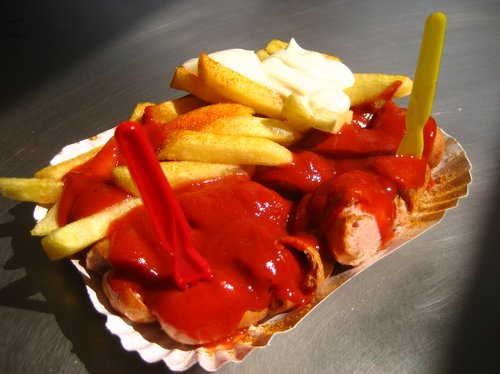
Check in, chuck your bags, and charge over to the Curry 36 stand in Western Kreuszberg for potentially the best of the (curry)wurst in town — grilled sausages sliced and drenched in ketchup and mayo and sprinkled with a mild chili powder. Death by drowning in this dip would not be a dishonourable one, methinks.

1 sausage with sauce cost €1.50 and 2 sausages with fries (below) cost less than €5.

IMG 1125IMG 1123

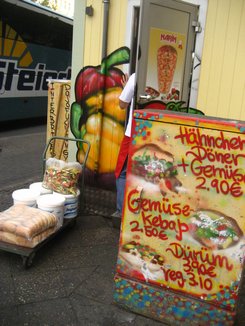
But be sure to show up hungry (or like me, greedy), or with friends, so that you can ALSO partake of Mustafas kebabs just a few steps away from Curry 36. The kebab stand will be hard to miss. The painted cable box greets you as you exit Mehringdamm station, as does the largest barrel of grilling kebab meat I have ever seen. The kebab itself will be hard to fit in your mouth, stuffed as it is with salad, roast veggies and feta. Again, this cost less than €5.

IMG 1193IMG 1118IMG 1131

Given their great bite-for-buck, I was tempted to simply spend all our meals in Berlin cruising wurst and kebab stands in each neighbourhood. Temptation came in all sorts of contraptions! E.g., a strap-on hot dog stand, and another fashioned from a converted wheelchair. Berlin’s creativity at its wurst.

IMG 1039IMG 1166

IMG 1026But that kind of kebab-crawl would likely require a lot more late-night clubbing than we had time or money more. So in our short stay we sampled only Tresor, a converted power station basement down the street from Hotel A&O Mitte where we were staying. The house music even at 4am wasn’t as hardcore as the uber-bunker setting (Guess I should’ve gotten off my ass and headed to Panorama, a recommendation from my music and nightlife expert pal Mogs).
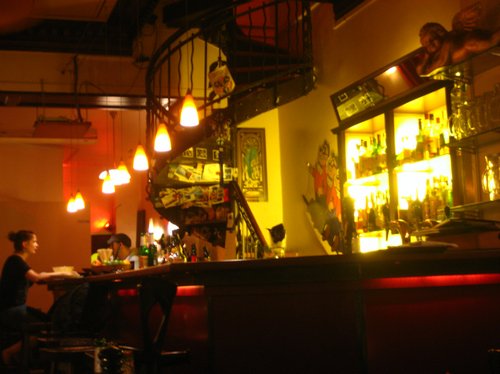
I was quite amused by Tresor’s doorbitch, though. And I quote: “Your sandals are a problem for the club…if you fall down the stairs it’s your problem”.

We’re not in London Zone 1 anymore, Toto.

Also tempting was Sage Club (down the street from Tresor), but Babs and I had dresscode problems there as well. Namely, we didn’t have any leather or PVC. So we boogied outside on the street corner where the music was pumping out of a building vent… with kebabs of course.

We took in a more genteel side of the city the next evening. Fellas was a cute bistro in the recently posh Prenzlauer Berg, which served giant and well made salads along with other classic continental offerings.

IMG 1073

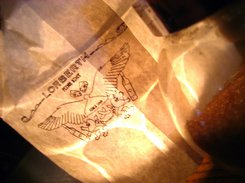
On a walking tour of “lofts-for sale” buildings in the neighbourhood after dinner, we chanced upon the very charming Lorberth cafe, which offered a range of organic desserts, coffees and teas (the latter served in large bowls). We settled on the delectable and none-too-sweet “old fashioned German blueberry cake”. I was quite taken with their shabby-chic lampshade — a paper bag stamped with their logo and placed over a candle in a glass.

IMG 1081IMG 1084

Wall to Wall Sightseeing

I realised only afterwards that the inedible part of my tour of Berlin centred around a “wall” theme.
2009 being the 20th anniversary of the fall of the Berlin Wall, Alexanderplatz had a magnificent exhibition on the history of the wall, the long-running opposition against it and the events leading up to its eventual fall.

IMG 1037

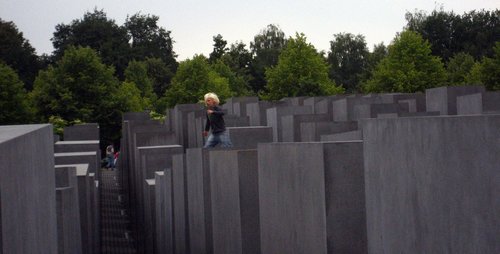
At both the Jewish Museum and the Holocaust Memorial, the walls of the structure housed exhibits but also were exhibits in their own right.

As Babs and I wandered around the forest of concrete blocks at the Holocaust Memorial (think an abstract representation of a cemetary) for example, we watched this kid below scamper back and forth across the block-tops. He’d cross our path from above every so often. A minute or 2 later an angry security guard would chase from behind from the ground below.

A few members of another group would race ahead of their friends, duck behind a block, and turn on them as they approached and “gun them down” like one of those 1st-person shoot-em-up games.

Curious. Chilling. Maybe too telling.

IMG 1184

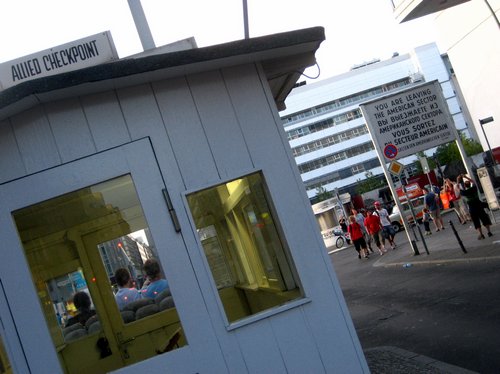
For my Cold-War-spy-novel fan Dad, I went to pay my respects at Checkpoint Charlie, the point of transit between the old West and East Berlin for many an emissary of espionage. The only walls here now are the ones going up on vast construction sites. The reconconstruction of the checkpoint itself looked sadly a tad kitschy — the 2nd photo below is more telling of how history played out.

IMG 1063IMG 1059

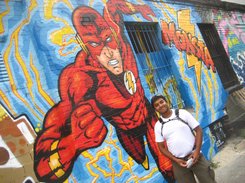
Most of what is left of the Berlin Wall itself is now better known as the East Side Gallery, a series of murals along the river Spree, now dotted with cafes, restaurants, and river tourboats. Various artists — some new and some returning from their original murals right after 1989 — are being commissioned to repaint sections of the wall.

IMG 1156IMG 1158IMG 1145

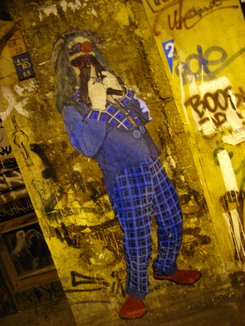
There are tons of walking and biking tours you can do in Berlin, depending on your niche interest, be it history, pub-crawling or even exploring underground tunnel systems. We signed up for the Alternative Berlin walking tour, and got a fabulous 5-hour introduction to the city’s best known street artists and popular street culture hangouts. The tour meets under the TV tower at Alexanderplatz at 11am and 1pm daily, and takes tips rather than charges a fee.

IMG 1089IMG 1134IMG 1086IMG 1114

IMG 1094IMG 1101

Above: Tacheles (meaning Straight Talk in Yiddish), the landmark artist squatter colony, is worth visiting as soon as possible, as it’s currently fighting an eviction notice from building owner Fundus, an investment fund that’s keen to build luxury apartments on the site (Related news story here). Right now, goodness knows why, really. As it is, Berlin is a city of ~4 million people but the city has space and infrastructure for 8 million. And there’s that little detail of global financing still being in the toilet. Anyway, those among you who feel strongly can sign a petition against the eviction notice onsite.

Overall, I can’t believe that it took me this long to get Berlin on my radar screen (evidence that I was never built to be one of the cool kids, really). So much history, so much new energy, and possibly most importantly, just so much space for all of it to keep growing without falling all over each other.

But to those who haven’t been or who have been long missing: Go now. Go soon. Because, really, new walls are coming up. And eventually the time will come, when they can be accessed only via checkbook charlie.

Curry 36 (and Mustafas kebabs)
Mehringdamm 36
10961 Kreuzberg, Berlin, Germany
+49 30 2517368

Fellas
Stargarder Straße 3
10437 Prenzlauer Berg
Berlin, Germany
+49 030 46796314

Lorberth
Pappelallee 77,
10437 Prenzlauer Berg
Berlin, Germany
+49 30 26349330

Read Full Post »

A few of my favourite fellow food dorks and I recently started an annual summer tradition I like to call “Melfi Mayhem”. Using our friend Melf’s birthday as a launchpad, we’d pick an idyllic location to eat, drink and be very very merry. The inaugural party in 2008 was on The Almalfi Coast in Italy, and this year we pounded the pintxos bars in San Sebastian in the north-east corner of Spain. We may have to take a meaty meander to Buenos Aires next year, but I have officially submitted Dubrovnik as a location candidate for 2011.

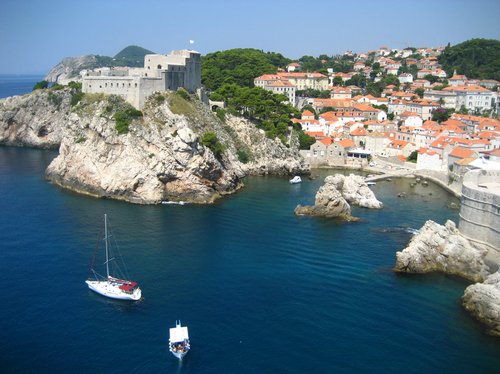
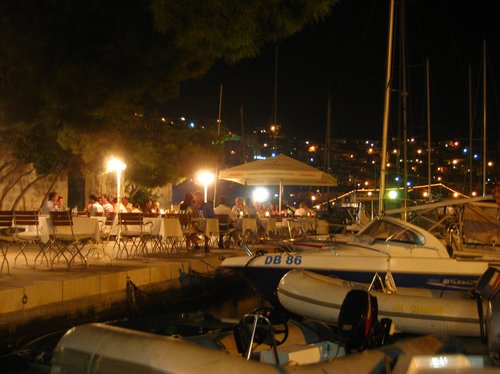
The pitch: Sapphire blue waters for swimming (still with various types of fish to keep you company no less, so go while you can), vermillion sunsets, an on-the-ball but chilled out service culture, and quite the formidable edible Adriatic aquarium, at reasonable prices.

IMG 0634IMG 0646IMG 0514

Here are 3 fine fishy finds from the recce trip.
Konoba Lokanda Peskarija

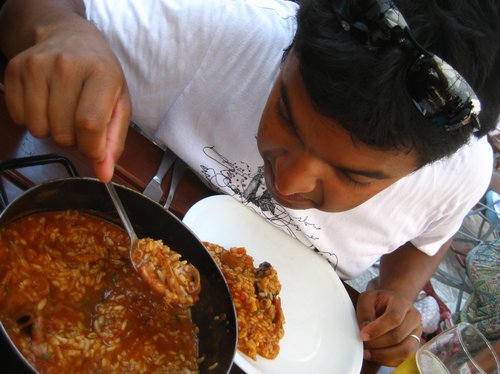
This was a great first stop in Dubrovnik, thanks to the advice of our fabulous hostess at Rooms Olga. Located at the old fish market harbour, Konoba Lokanda Peskarija won us over with big pots of fresh local product at fair prices. Below, I play peekaboo with mussels while Babs parses out the risotto. The style of the risotto is more reminiscent of Portugal than Italian risotto or Spanish paella. Apparently the risotto ala terroir is the squid ink kind; I didn’t order it only because I find the stuff really addictive and could end up eating it at every meal for our remaining 4 days (like I did on previous occasions in Barcelona and Venice).
IMG 0468IMG 0469

Orsan

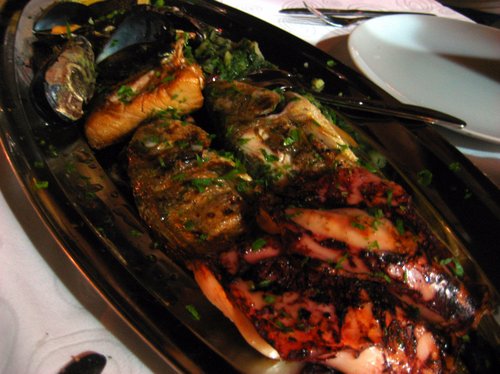
You can dine at the water’s edge (literally) at Orsan, located at Dubrovnik’s local yacht club, another recommendation from the owners of Rooms Olga. The octopus salad was beautifully crunchy, unlike the soggy and slightly powdery renditions in too many London locations. After hemming and hawing over mains, Babs and I embraced our indecision and got the seafood platter, with roasted squid, 2 kinds of fish and mussels. Oh for the days of a yuppy budget. Ah well. Sandwiches and fruit for lunch tomorrow it is, then.

IMG 0532IMG 0522IMG 0524

Restaurant Lindo

Between getting a very late start and then getting off at the wrong bus stop — which meant walking for another 30 minutes slightly uphill in the hot and muggy afternoon heat — we got to Restaurant Lindo at the fairly awkward hour of 3.30pm for lunch. Their hospitality was as old school as their Croatian menu, thankfully.

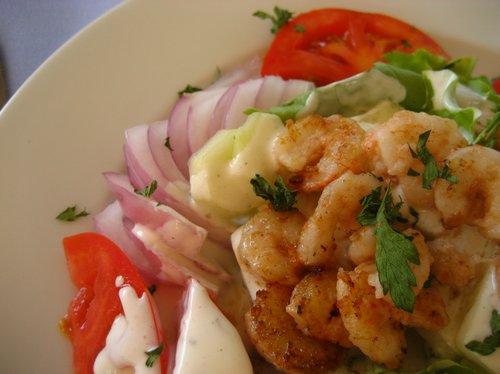
The fish soup was simple but strong, and Babs is keen to replicate their home-made bread. Very unfortunately because we were between meal shifts I didn’t get to try their slow roast meats (kept in a heavy iron pot and covered in hot ash on an open fire) as those need to be ordered in advance, but I was sufficiently placated by the house-special salad of tomatoes (at the height of their season in town judging by everyone’s garden patches), cucumbers, onion, shrimp and a light yoghurt dressing. Think Indian raita pimped up with shrimp. I’ll need to try making this when I have kitchen access again.

IMG 0535IMG 0536IMG 0538

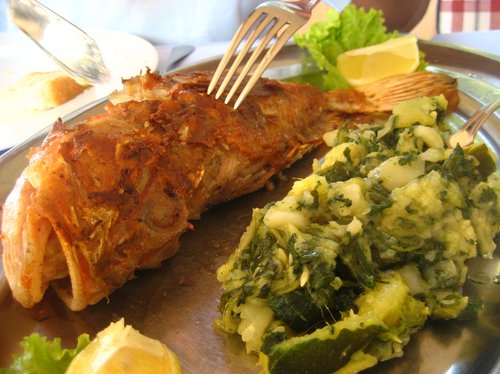
The waiter offers to fillet our grilled scorpion fish for us. We can’t shoo him away fast enough. On the right is swiss chard cooked with potato, a popular local stodge-&-greens-in-one side dish.

IMG 0541

After lunch, a little jaunt in a laser. I sit up front, clinging to the mast like Odysseus before sailing into siren-land. We scheme about coming back here sooner rather than later. Next time, up and around the Dalmation islands. With a bigger boat. And friends.

IMG 0714

Konoba Lokanda Peskarija
Gorica Sv. Vlaha 77
20000 Dubrovnik, Croatia
+385 20 324747

(Couldn’t get Gmap to pintpoint well, but this is easy to find. Just ask locals for the old fishmarket harbour, where the tour boats to the islands come and go)
Orsan
Ivana Zajca 2 (at the yacht club)
20000 Dubrovnik, Croatia
+385 20 435 933
Restaurant Lindo
Iva Dulcica 39, Babin Kuk
20000 Dubrovnik, Croatia
+385 20 448 351

(Follow directions to the President hotel resort. The restaurant is part of the accompanying low-rise retail complex)

Read Full Post »

A Bari Delightful Day

IMG 0422

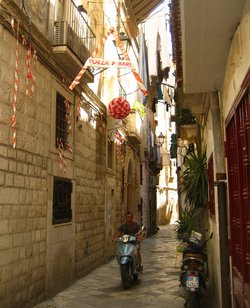
Maybe it’s true that everything’s better if you have no expectations. Or maybe we were so stressed out by Rome that the return to the charm of a less built up part of Italy was especially keenly felt. In any case, the 15 or so hours spent in the Adriatic port town of Bari — our transit point between an overnight train from Rome and an overnight ferry to Dubrovnik — were quite delightful.

Not that I could claim to know it beforehand, but Bari is the capital of the Puglia region and is the 2nd largest city after Naples in Southern Italy. In addition to fishing and trade, the city seems to thrive on a large grid of swank shopping boulevards.

Historically known as the exit doors of Italy where locals and visitors board boats for Greece and Croatia (as we did), the local government has been working hard to promote Bari as a destination in itself. Each September, for example, the city hosts the massive Fiera del Levante trade and industry fair. My ever-hip friend Goz also sent an alert about the avant garde Fame art festival in Grottaglie — an hour southeast of Bari — opening in mid September this year (2009).

With much less ambition and agenda, we had breakfast at 8am at a cafe near the train station, and watched with bleary eyes the locals coming and going as they grabbed coffee and pastries on their way to work.

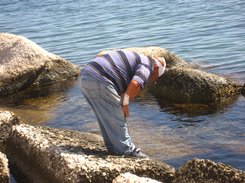
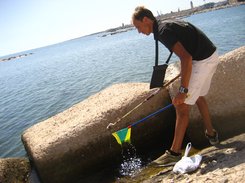
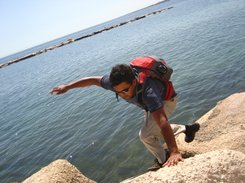
After, we decided to walk along the coastline in a bid to recce the port. Others also soaking in the morning light included clumps of heroically pot-bellied old men (talking and gesticulating at each other in that classically dramatic Italian fashion), and locals hunting among the sea-wall rocks for little fish and crabs. The man on the right proudly showed me his catch.

IMG 0436IMG 0428IMG 0429

Babs joins in on some crab-hunting action with his camera.

IMG 0431IMG 0432

I’m not a morning person, but if there’s one thing I do like about having time to kill in the early hours of the day, it’s checking out and dawdling at local markets, like the one at the entrance of Bari Vecchia, Bari’s medieval old town.

IMG 0416

Right across from the market we chanced upon Osteria Con Cucina, a subterranean dining room where we had a scrumptious 4-course lunch and coffee. There was no menu — the owner just listed a few options for the primi and secondi courses. And there was no option to have only 1 course, as some tourists a few tables away tried to do. Each meal, no matter what you picked, came to €20 per person. This is more like the Italy I know and love!
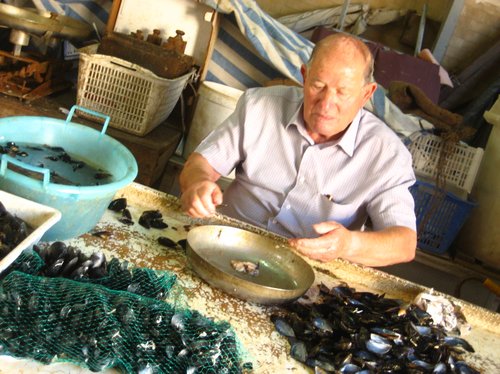
Even more entertaining was sneaking glances at the big black suited Italian dude at the table next to us, reading the sports pages of the local paper. He scarfed down a platter of raw mussels, then a large plate of seafood linguine. Evidently he had access to a special menu, perhaps one reserved for non-tourists, or regulars, or members of the family, or members of the other family.

After Mr Big Black Suit was done he strode into the kitchen to chat with the chef, then to the bar to chat with the owner (I craned my neck but couldn’t see round the pillar to check if he paid like everyone else) before leaving.

Ah well. Back to lunch.

Antipasti: Toasted bread rubbed with olive oil and tomato, with rocket and new potatoes; Bits of ham, olives and 2 types of cheese.

IMG 0437IMG 0439

Primi: Bari’s most famous dish (and rightly so), riso, patate e cozze (rice, potatoes and mussels) with everything cooked (baked?) in a briny stock. I’ll need to try and make this sometime. Below: A very well made pasta with seafood, with clams, mussels, shrimp and squid.

IMG 0441

IMG 0443

Secondi: Roasted octopus, entirely intact. The waiter chuckled at how gleeful I was looking.

IMG 0448

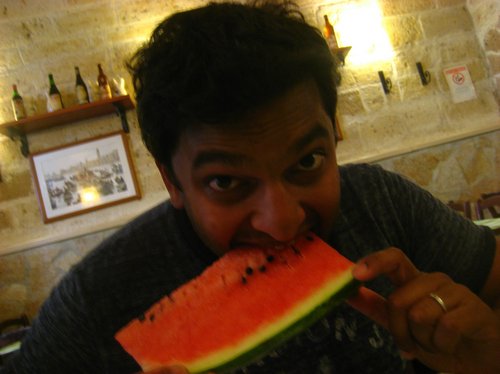
Dolci: Chilled watermelon — a godsend for a scorching summer day.

IMG 0450

The rest of the day was spent reading on park benches, walking around the town’s old castles and churches (Wikipedia provides a good list with descriptions in its “Main Sights” section), searching in vain for an internet cafe, and even setting off on an eventually unsuccessful expedition to use the showers at the municipal swimming pool.

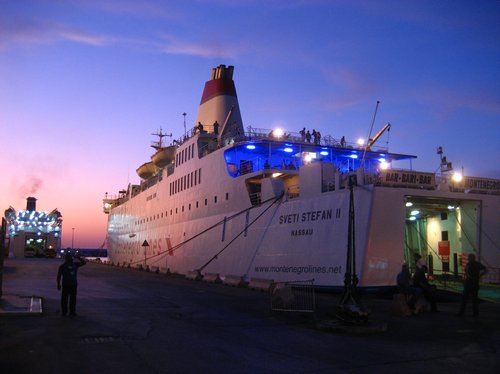
Eventually it came time to board our overnight ferry to Dubrovnik, where we again bought deck seats instead of bunks.

IMG 0454

We settled in for the night on a couple of wooden benches on the outdoor deck under the stars, using our daypacks as pillows. We were sweaty and sticky, on the 2nd night in a row sleeping on the move. Usually I’d be in a slightly psychotic state by now, but I was still floating on the memory of a very delicious lunch.

It would seem that a little well-cooked pulpo can go a bari long way.

Osteria con Cucina
Strada Vallisa, 23
Bari, Italy

Read Full Post »

In a bid to minimise the number of flights taken on this sabbatical, Babs and I crossed the Mediterranean from Barcelona to Civitavecchia (the port of Rome) by taking a 20-hour Grimaldi lines ferry, which takes pedestrians, passenger cars and campers, and cargo trucks.

To economise we booked €55 deck seats instead of > €100 bunks, and they were fortunately comfortable enough for a decent sleep (picture business class seats on a mediocre airline). Savvier (but heavier laden) backpackers simply found free corners in the indoor deck, or curled up on the floor under their seats, and crawled into their sleeping bags padded by roll-up foam mats.

There was even a big-screen TV at the front of the room and I spent a very entranced hour watching CSI dubbed in Italian.

During the daylight hours, Babs and I settled into one of the cushy booths in the large bar/lounge where I did a lot of daydreaming, reading, writing and even napping to pass the time.

All in all, a very pleasant way to travel slowly, but a word of advice to those who are tight on budget but big on food: Drop by La Boqueria or Mercat Barceloneta and pack a picnic before getting on board, to avoid mediocre food priced for a captive audience.

Bye bye Barca. I miss you already.

IMG 0228

The ever irresistable Babs makes a new friend — a businessman making deliveries in Rome and Sardinia (we didn’t dare to ask what). In a mish mash of English, Spanish and French, we learn from him that Sardinia (which we wanted to go to but alas didn’t) was going to be as expensive as Rome anyway. Not to mention there were ongoing bushfires at the time.

IMG 0264

We eventually reach Civitavecchia at dusk, but still need to find the train station to catch a 90-minute connecting train to central Rome. Babs — not impressed with the organisation of the free port buses — turns on his internal “Babbinav” radar and rockets off on foot.

I plod along behind with backpack and daypack, and watch 3 port buses pass us by. Ah well. Might as well make the best of it and take in the sights of the Roman port along the way.

IMG 0282

A local fisherman — with ALL his goods on display — is as amused at the sight of me as I am of him.

IMG 0279

Read Full Post »

IMG 0045

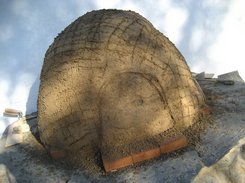
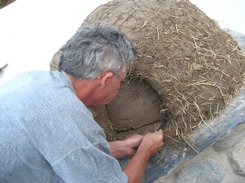
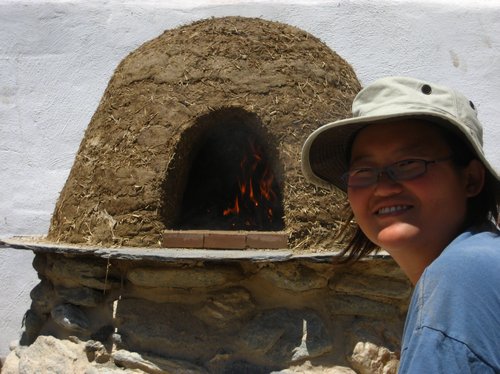
It was a labour of love, involving blood (mud-&-straw clumps scratching up our hands), sweat (building under the Spanish summer sun) and tears (when a supporting structure collapsed for the 3rd time).

An outdoor oven is one of those things Babs and I nurse ambitions about having someday, in that yet-to-be-identified place where we will eventually settle down (along with a massive charcoal BBQ pit and motorised roast spit). So I jumped at the opportunity to learn how to build one… by actually building one, while WWOOFING at Anthony and Catherine’s finca in Orgiva, Spain.

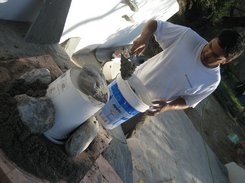
Our reference guide for the project was Build Your Own Earth Oven by Kiko Denzer. One of Denzer’s main principles is to use recycled and/or foraged materials, so that cost of building will tax neither your pocket, nor the envioronment. The only materials Anthony bought were ~30 firebricks (a few spare) and a few pieces of slate. The rest of it was sand from the beach in Motril, clay fand rocks from nearby riverbeds, and dirt and straw from the farm.

The Base

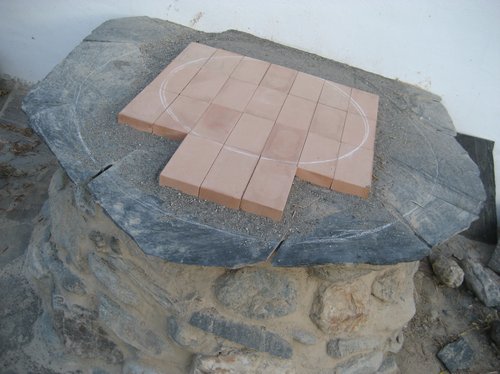
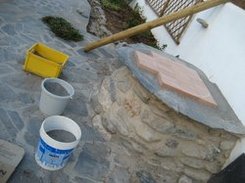
Anthony had already completed the base when we arrived. It’s a ringed stone wall, filled in with rubble. Right at the top it has insulating layers of clay and sand. The stone wall is self-supporting, but the crevices have been plastered up tight with mud and clay to prevent wasps from building nests in the gaps (The stone wall must have looked like a luxe condo block for waspy property hunters). On top of the slate are the firebricks (built denser than regular bricks to retain heat). This is the cooking floor of the oven.

IMG 0033

The Support Dome

Question: If you’re building a dome which has a base radius of 33cm and a height of 48cm, how many buckets of sand from Motril do you need? Answer: Many more than you think.

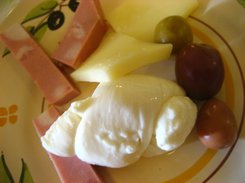
In any case, the shortage was a great excuse to do a day trip to the beach. To improvise in the meantime, we bulked up dome volume with an upturned bucket, a few rocks and lots of gravel. It might have been due to this makeshift base, or the coarseness of the sand, or the startling evaporation rate, or one of our sandcastle building techniques (as Babs and I hotly debated) but we had 3 major sandslides before completion.
IMG 0032IMG 0036

IMG 0038IMG 0040

IMG 0066

Above: Babs VERY GINGERLY puts wet newspaper and sackcloth on the completed sand dome to help keep its shape while I hold my breath

The Baking Layer

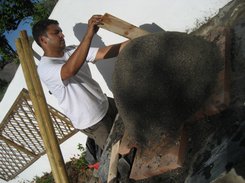
This first layer of mud and clay is what absorbs heat from burning wood in the oven, then radiates it back onto food. We had too much water in the mix, leading to lots of “flab” from sinking clay (what is it they say about ovens resembling their makers?). After it solidified sufficiently, Anthony did some nip tuck, and we marked out the door and scored the roof to help it bond with the next coming layer.

IMG 0065IMG 0070

IMG 0083IMG 0086

Additional Heat Retention Layer

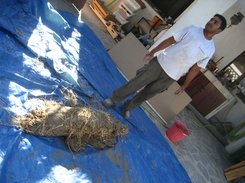
Again this layer is made of mud and clay, but with straw mixed in. You can build an entire house out of this stuff, as is the case in various pockets of the English countryside, Africa, Central America and more recently Gaza.

Getting the straw to bond evenly with the mud is quite the task (Denzer recommends you get all the kids in the family or the community involved). Two people walking on it took too long, so we eventually blasted music from the house to get things really jumpin’.

IMG 0088IMG 0090

IMG 0091IMG 0099

IMG 0101IMG 0095

S6301033

Cutting Out the Door and Hollowing Out the Oven

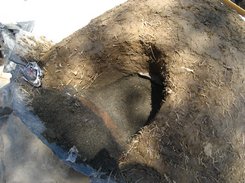
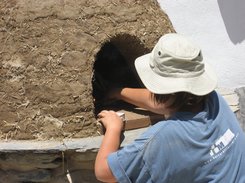
After running out of mud and straw for the day, we let the furry-winter-hat-looking structure dry out overnight. The next morning, Anthony and Babs debated about whether it was dry enough to cut out the door, and excavate the sand dome. Babs was convinced only after he personally conducted the very technical “squidge” test (3rd photo).

IMG 0001IMG 0003

IMG 0007IMG 0012

IMG 0023IMG 0026

Above: For those of you trying this at home: If you’re going to use an upturned bucket to pad out your base, make sure it’s not too much larger than the intended height of your door!

S6301062

Above: Team WABS, our hosts Catherine and Anthony, and our functionally finished oven

Drying Out the Oven

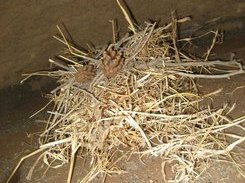
We now have a functional oven structure! There’s a 3rd layer (about 1-2 inches thick) that will eventually go on, but it’s mostly decorative. In the meantime, it’s time to start a little fire to dry out the oven from the inside. Babs and I can barely contain our pyro-glee as we slap together a clump of straw, twigs (2 sizes), a little log and a couple of pine cones for laughs. The team very graciously lets me light the flame. It burns beautifully. Babs and I spend the next hour just sitting on the floor staring at the flame and tossing in twigs and logs.

IMG 0029IMG 0027

IMG 0030IMG 0032

IMG 0034IMG 0037

IMG 0044

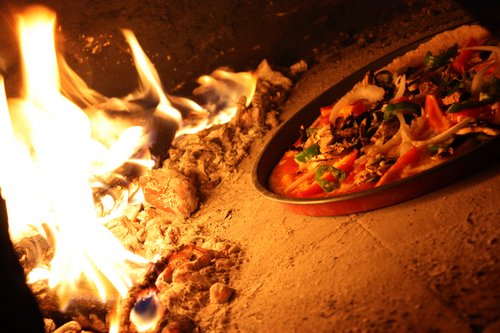
Our First Pizza!

Given we’ll be needing to crank out pizzas for ~30 people this Saturday, the (ahem) professional thing to do was to test-drive the new oven for Monday night’s dinner. Current cooking time for 1 perfect pizza currently takes 5-8 minutes. The assignment for Wednesday lunch is to experiment with timing of pizza entry and burning-log placement, to reduce cooking time and improve even-ness of heat distribution. I forsee Babs and I insisting on a lot of practice.

If only all projects were this delicious and satisfying.
IMG 1859

IMG 1855

Read Full Post »

Posts on Restaurant Kursaal in San Sebastian and our quick stop in Granada are still in the works. In the meantime I thought I’d share a half-time report on our WWOOFing stint in Orgvia, Spain.

Early high points:

  • Orange juice from the oranges we picked just before lunch
  • Watching 1,000 yr old aquaducts built by the Moors water 400-yr-old olive trees
  • Plowing through our hosts’ bookshelves during siesta

Early low points:

  • Breathing so hard while working in the heat that you inhale a midge, and spend the rest of the day gagging on it, long after probably swallowing it
  • Weeds that beat you at tug-of-war

What on earth is WWOOFing?

WWOOF stands for World Wide Opportunities on Organic Farms. In summary you volunteer on an (often small) organic farm for an agreed number of hours a day and days a week, in exchange for food and accomodation. Along the way, you learn about different organic farming methods and sustainable living, as well as get an insider and rural view of the country you’re WWOOFing in. Your WWOOF host gets some sweat and muscle (and sometimes creativity and complementary knowledge) on the cheap. No money is exchanged, so no nasty work visa paperwork is needed. You pay a nominal WWOOF network membership fee to keep the network up and running.

This sounded like a genius proposition to Babs and me. We’d get to learn a little more about the food chain, AND stretch our travel budget. We decided Spain was a good place to start, and after writing to 12 hosts in various bits of the country, providence led us to a 3-week stint with Anthony and Catherine and their 3 acres of olive and orange trees in Orgiva.

Anthony and Catherine moved to Orgiva 2.5 years ago and have since built their house and the infrastructure around their homestead bit by bit, with plenty of patience and good humour. Before moving to Spain they spent the last 2 decades teaching children with special needs. I noted this with some optimism – perhaps they’ll have some patience for the occasional daftness of a lifetime city girl!

Orgiva Where?

IMG 0032

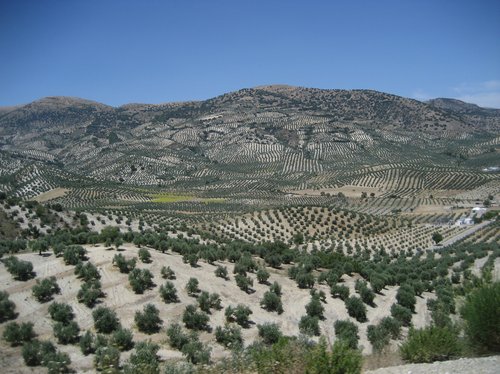
Above: This is an optical illusion of the idyllic farming life. Swaths of land planting just 1 type of crop creates chemical imbalances in the soil over time. The wide brown paths between the olive trees ease the way for the harvesting machine, but the exposed topsoil (where the nutrients are) is vulnerable to wind and flood erosion

Orgiva is the administrative capital of the Andalucia region, about an hour south of Granada in the foothills of the Sierra Nevada. It also turns out that Orgiva’s immediate surroundings — Las Alpujarras — are the setting of Driving Over Lemons by ex-Genesis drummer Chris Stewart, the first of his autobiographical Lemons Trilogy about uprooting from the UK and building a new life among peasant Spanish farmers.

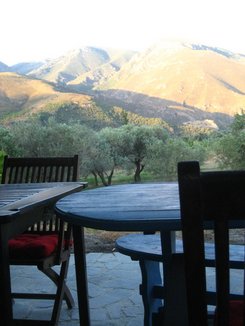
Two decades worth of Dutch, German and Brits — blackberry-beeping businessmen and barefoot-as-a-lifestyle-choice-hippies alike — decided the same, making the neighbourhood a strange little agricultural cosmopolis. It’s not entirely hard to see why. Below is the view from our breakfast table on the front porch, and a few peeks around our hosts’ garden.

IMG 0080IMG 0107

IMG 0014

IMG 0051

Where Do We Fit In?

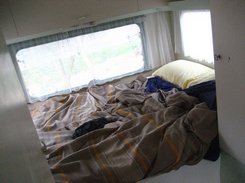
Specifically, in a 34-yr-old caravan in the back terrace of olive and orange trees, right next to a large patch of mint. So during the sweltering Spanish siesta, our caravan smells like Moroccan lemonade.

IMG 0078IMG 0077

IMG 0074IMG 0075

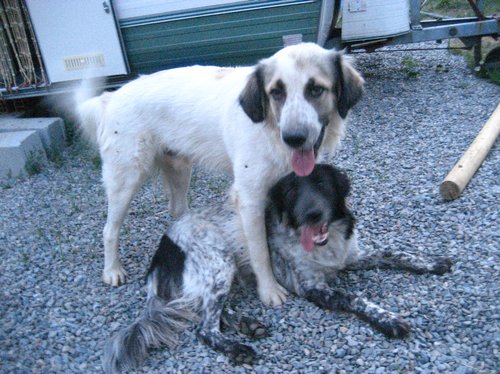
In addition to our hosts, we have dos chien Andalus, Zumba (the cream-coloured one) and his mother Oliva for regular company and entertainment. Hilarious when they’re horsing around, half as hilarious when Zumba bounds off with our solar torch in his mouth, usually at dusk.

IMG 0050

For our 3-week stint, we have 2 major projects: 1) Build an outdoor oven, and 2) Build a compost toilet. Both are partly a lead up to Catherine’s birthday weekend bash on July 18.

IMG 0031IMG 0020

There are also the more day-to-day tasks of upkeeping the farm: Pruning trees, ripping out monster weeds choking up irrigation channels, and replacing knackered recycled wine and beer bottles around the vegetable beds.

IMG 0042IMG 0044

IMG 0047

Our day starts at 7.30am and we try and get in the heaviest tasks done before breakfast, before the sun really goes into overdrive. The shift between breakfast and lunch goes about 5 times as slowly and we’ve since learnt the art of tracking the path of the sun and planning our course for hopping between tree shadows to get as much done as comfortably as we can manage. We wrap up at about 1.30pm (it’s too hot to work after), have lunch, shower and pootle about for the rest of the day.

IMG 0046

Above: Babs checking out our hosts’s alberca, part river-&-rainwater storage pond, part swimming pool.

So far, so good! Stay tuned!

Coming soon: Building a Bread Oven

Read Full Post »

Ola!

So it’s been 4 days of work on the farm and today’s an off day (we’re also taking tue off to go to the beach).

Major tasks have been getting materials ready to build an outdoor bread oven, building a concrete wall for a compost toilet, pruning olive trees and clearing monster weeds from the main irrigation channels to improve speed and volume of water going down to the trees lower down the slope.

We start at 7.30am and finish at 2pm cos it’s too hot to work after that. Hard work but very satisfying to see the results. Just not yet convinced I would want to do this long term (esp cos Babs and I are still wrestling with how it is at all economically sustainable). It’s a very pleasant lifestyle though, and I’m told the weather is ridiculously comfortable in spring and autumn.

Our hosts are vegetarian and obviously we eat what they eat, so all in all, am currently experiencing the healthiest lifestyle I’ve had, probably ever.

Am glad we’ll have another 2 weeks here (which culminates in one of the host’s birthday party). We’ll get to finish the bread oven and compost toilet, and the travel budget will be back in good shape (after the gluttony of San Sebastien)

P.S. Recently finished The Little Prince, and currently reading George Orwell’s Homage to Catalonia. Have always been an Orwell fan and this continues.

Read Full Post »

A quick one, not focused on food. Hopefully this provides a few helpful nuggets if you’re planning a visit to Bruges. If you’ve already been, and have advice to add (especially Bruge restaurant recommendations) I’d love to hear from you.

IMG 1571

A little Bruges sky thinking


Getting to Bruges

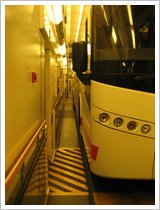
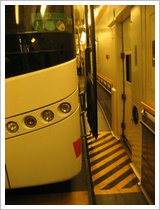
The closest international airport is Brussels, and from there it’s another 1 hour train journey to Bruge. If visiting from Europe, train lines are well connected. We took a 6 hr bus ride from London for £25 per person. The bus sat in a train carriage while going through the EuroTunnel. Kinda like a heavy transport version of turducken.

IMG 0110IMG 0115IMG 0116

Staying in Bruges

Bruge is a tiny walkable city, and the footpaths radiating around the old city are lush with flora and canals. So if on a budget, staying outside of the city gates might be a more value-for-money option. We paid €55 a night for a double-bed with ensuite bathroom.

Het Wit Beertje (their website shows photos that are pretty accurate)
Witte Beerstraat 4
Bruges

Our host Jean-Pierre Defour was friendly, attentive and served a generous breakfast of bread, vanilla custard pastry, meat, cheese and cucumber yoghurt (and fruit and yoghurt off screen).

IMG 0072

Getting around in Bruge

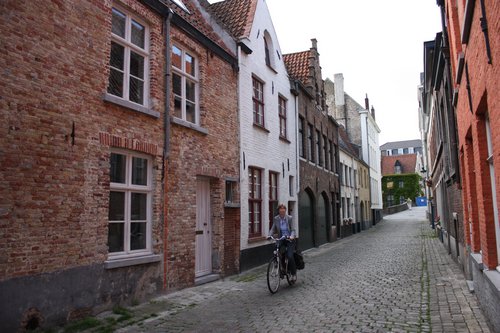
You can walk the entire old city in a day, and going on foot makes it easy to nip into quiet pretty little residential lanes.

IMG 1582

IMG 1585

Or for the full tourist experience, you can canter around town in a horse carriage or do a boat tour of the canals.

IMG 0011IMG 0030

Things to do in Bruge

Besides the usual art and city history museums, 4 slightly kookier options are the Haalve Maan Brewery Museum, the Diamond Museum, the Friet Museum and the Chocolate Museum. The latter 2 have many “exhibits” for tasting and the Chocolate Museum sells all kinds of moulds for home-based chocolatiers.

IMG 0018IMG 0023

IMG 1540IMG 1560

Five Fun Friet Facts, and then Farewell

  • Potatoes were largely shunned as poor man’s food when they were first introduced in England. Their market value rose only after a savvy farmer put fences and guards around his potato fields, making them seem valueable. Gotta love old school marketing
  • China is currently the largest global producer of potatotes, even though potatoes play no significant role in Chinese cuisine
  • Friets are allegedly a Belgian invention. Fishermen who caught and fried little minnows tossed potato bits into hot oil one harsh winter when the fish weren’t biting.
  • Friets ended up being called French Fries in America because some French-speaking Belgian soldiers offered them to some American soldiers during WWII. The Belgian soldiers never got around to correcting them, possibly because they didn’t think Walloon Fries sounded much better
  • Friets were traditionally fried in a mixture of beef fat and horse fat

For more research and ideas on Bruges, Wikitravel provides a well-researched write-up.

Read Full Post »

In Bruges

Wen and Obelix

We made it through our first stop, Bruges, a pretty town with great weather (while we were here), which was lucky as we’re only starting to get to grips with living on a tight budget, and walking around pretty towns in good weather is, well, free.
Wen and many types of potato

The only tourist attraction we splashed out on was a combined ticket to the frites museum and the chocolate museum. Two of my favourite, if not healthiest, foods – how could we resist? The museums were educational too, weaving in the native American histories of each with stories of the European explorers who brought them eventually to Belgium’s shores.

More pics of Bruges

Amir

Read Full Post »

« Newer Posts