Feeds:
Posts
Comments

IMG 2659The other Accidental Istanbullu thing we did while waiting for our Indian visas in Istanbul this past September, was to take another little vacation from our vacation.

We decided to go with the smallest, most remote seaside village we could find in our Lonely Planet Guide within a 3-hr travel radius of Istanbul. Kiyikoy on the Black Sea Coast — population ~2,000 — with allegedly more fish, frogs and tortoises than people, and with nary a detail on Wiki Travel and Google Maps, sounded perfect.

We weren’t disappointed.

We took a long metro ride to Istabul’s central bus station, then 2 buses on to Kiyikoy. True to the old adage that the journey counts for as much as the destination, we had some hair-raising entertainment(?) on our bus ride when our driver and a rival bus company driver got into a loud scuffle at one stop, got separated by their colleagues, then came storming back to each other, armed. I wasn’t keen on the odds, given our driver’s big stick was up against the other driver’s kitchen knife. Thankfully they got separated again, properly this time.

We got to Kiyikoy in the late afternoon, and used the rest of the daylight to soak up the view from our lovely cliff-side boutique abode, Hotel Endorfina.

IMG 2644

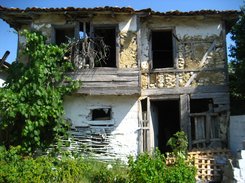
The next morning, we set out to walk around the little farming and fishing village nestled behind the old city walls. Sadly, there were quite a few of these gutted stone and wood houses below, as locals moved out into the “suburbs” dotted with more modern but far less charming concrete houses.

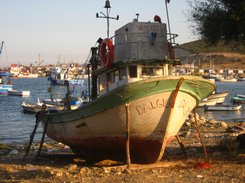
IMG 2658IMG 2660IMG 2889IMG 2961

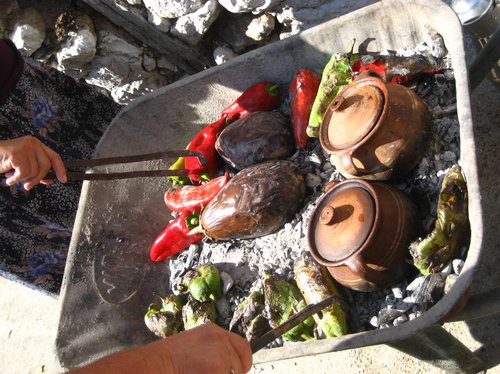
A lovely unmistakeable perfume of food being smoked wafted through the air. We followed our noses into a little alleyway between 2 houses and found this coven of women cooking peppers, eggplant and claypot stews on a wheelbarrow full of coals. My enthusiastic gestures of “smells very good!” got the women to chuckle and beckon me closer for a better look.

IMG 2664IMG 2667

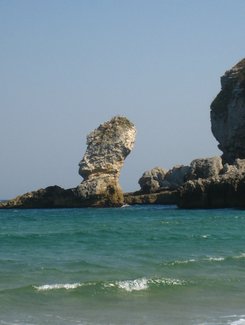
Onward to the water. We watched 2 boys take potshots at seagulls. I wondered if this Old Man of the Sea down below approved.

IMG 2670IMG 2784

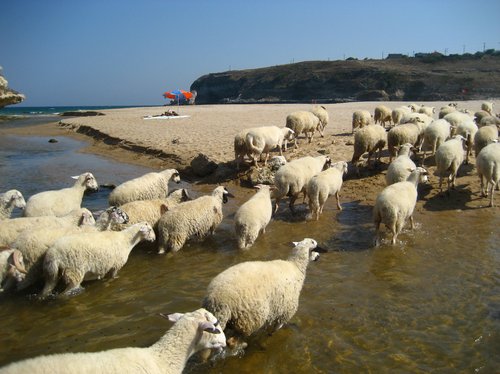
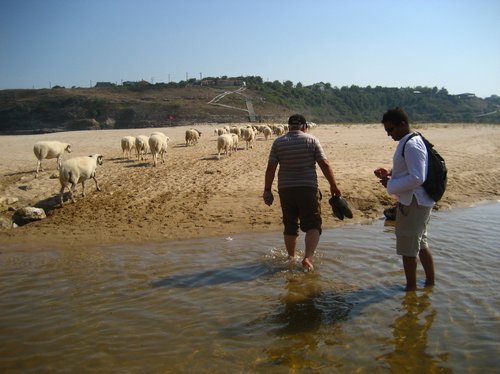
Making our way down to the beach from the cliff, I heard a gentle cling-clanging chorus behind us. I turned to find a flock of sheep about to overtake us! Would these count as salt-marsh lambs, y’think?

IMG 2799IMG 2803

Their shepherd stopped for a few minutes to chat. Well. That is to say, from behind me he yelled “JAH-PAHN! JAH-PAHN! JAH-PAHN!” until I turned around and yelled back “SINGAPORE!”

He pulled up alongside, replied, “Ahhhh. Singah-puuur. Singah-puuuuur….uhn…”, and then moseyed on, possibly wondering where or what the hell Singapore was. We saw him again the next day, somewhere in the middle of the village, again with his flock. No hollering of nationalities this time, just a smile and wave to each other.
IMG 2809

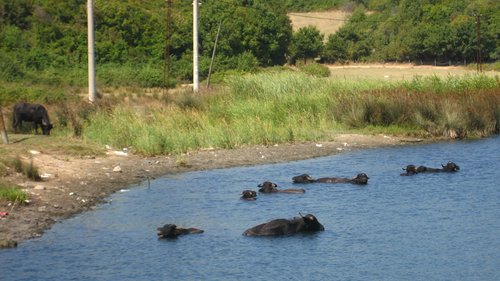
We decided to join these buffalo in the river…
IMG 2690

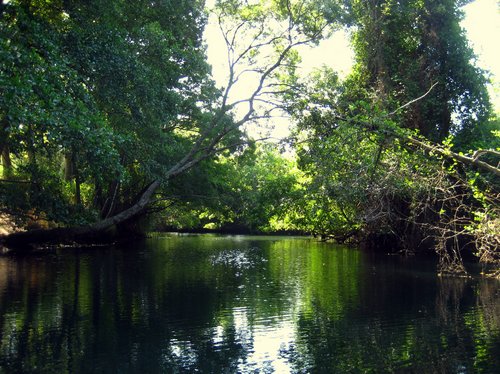
…though in a paddleboat. Below, the view from a few kilometres upriver. The tortoises and frogs didn’t disappoint. We even saw a few jumping fish! Twas all very summertime, and the living is easy…
IMG 2725IMG 2710IMG 2756

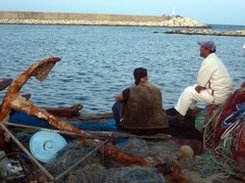
IMG 2819All that exercise sent us prowling for lunch. I’m pretty sure the eatery we ended up at didn’t have a name. But it’s on Kiyikoy’s main street, peppered with leathery fishermen sipping tea and playing tavla, and run by this handsome gentlemen on the right. I had a good feeling about the place when the big burly guy who runs ATV tours at our hotel popped in, started bantering with the owner and poking about the tiny kitchen to see what was being made.

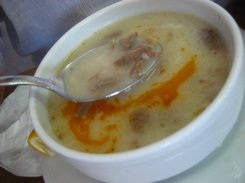
Hearty chicken kebab in fluffy turkish baguette aside, of special note was this corbasi (soup) below.

“Meat or lentil,” the owner asked in Turkish.

Meat.

“(something I couldn’t understand)?”

Uhm….

The owner points to his head, then to his gut.

Uhm???!!!…
IMG 2821

He then showed me a box of thin-sliced tripe.

Ahhhh.

I wasn’t quite in the mood for tripe, so I said the other thing, before fully realising he might have meant “brain”.

Luckily, it was just little flecks of meat. Maybe face or cheeks then. And a loose scattering of rice. And — a amazing little addition I’m going to start using creamy soups when I get home — a spoonful raw minced garlic. So stinky, but soooooo diabolically good.

I quite like this town.
Moscow: (Food) Gawky Park

IMG 2226

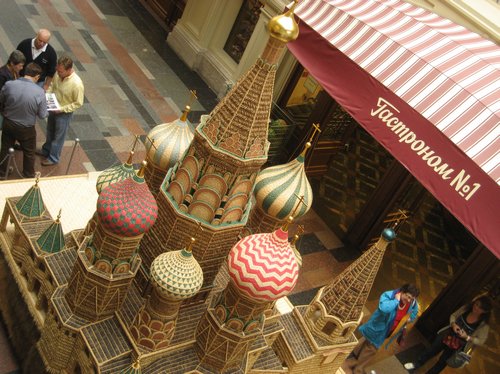
Above: A replica of St Basil’s Cathedral made from grains, at the entrance of the uberposh Gastronom No. 1 Food Hall at the GUM luxury mall on Red Square (right across from Lenin’s tomb, poetically)

Top tip on traveling and eating in Moscow? Go when you have money. Preferably backed by commodity du jour, with a side order of a English Premier League football team. Or else do a massive amount of research beforehand on value-for-money local and street food haunts before showing up. Otherwise, it’s simply a metropolis of slick and expensive restaurants of every ilk of global cuisine. Very exciting for local and expat residents do doubt, but exhausting for a frugal foodie backpacker hoping to chance upon something cheap, cheerful, and core to the indigenous food scene.

Crunched on time and budget, and let down by 2 distinctly budget-busting-but-ultimately-“meh” Georgian restaurants, we did the next best thing to console ourselves; a little food gawking.

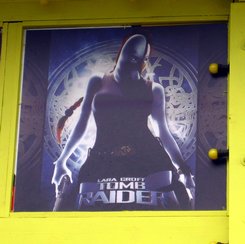
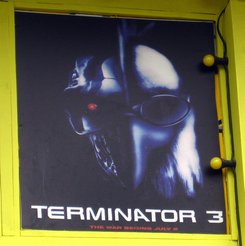
Especially amusing were these signboards below at a fried chicken shop at Gorky Park, the city’s historic sprawling recreation centre and amusement park for locals.

IMG 2294IMG 2295IMG 2297IMG 2298

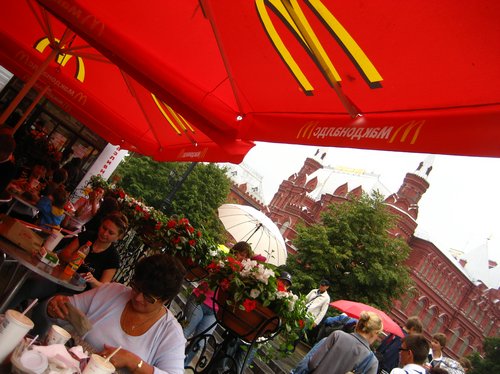
For a while I entertained the idea that the one place on this round-the-world sabbatical that might be appropriate to eat at Micky D’s would be at Moscow’s Red Square. The place was absolutely mobbed (I mean crowded, not necessarily occupied by local goombas). It was a case of Russian Breadlines: The Capitalist Remix. I decided that life was too short and there had to be a better use for my already too-few rubles.

IMG 2271

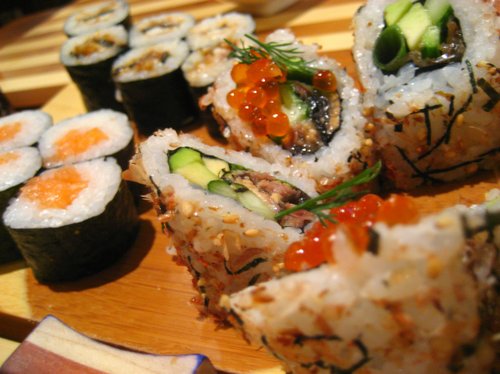
I noted with curiosity that there was a slew of sushi joints all over St Petersburg and Moscow. And peering at diners’ platters from the sidewalk, the sushi actually looked credible. You can kinda tell when a city is just starting to get into sushi but sushi chefs and local palettes haven’t been trained up yet. The rice looks dry and loose grains fall all over the platter. The maguro is an anaemic pink rather than a healthy deep maroon. And people are eating mostly plastic looking california rolls with crabsticks and neon pickles. But this was not the case in Moscow.

According to Peter, our guide in St Petersburg, sushi’s become quite the staple for urban Russia’s aspirational middle class over the last decade or so. Sushi has a great combination of a having designer look and exotic vibe, and apparently is especially popular among young Russian women looking to reduce their stodge intake.

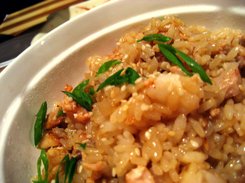
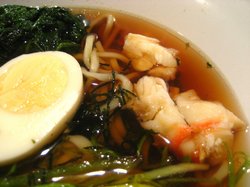
So before camping out at Sheremetyevo Airport for the night to catch a early morning flight to Istanbul, we followed the lead of the locals and had sushi for dinner. We popped into Yakitoriya (a long list of branches throughout Moscow, and a delivery service to boot) where the sushi and ramen were credible for the price.

IMG 2328IMG 2322IMG 2325

Next time I come back here, if ever, I’ll follow my own advice. In the meantime, bring on Istanbul!

A few quick glimpses from wandering around St Petersburg, Russia, in late August this year.

Statue of Peter the Great, immortalised in world literature by Pushkin’s The Bronze Horseman, an epic poem about man against the elements. Peter the First envisioned a new coastal capital for the Russian empire… built on a swamp…that would be frozen for a good chunk of the year. Apparently when his engineers told him that this swamp would be completely untenable for building for many months at a time, he said something to the effect of “Well you’d better work faster then”.

IMG 2128

Old men playing chess on Nevsky Prospect.

IMG 1938

Young men dancing in front of the Hermitage Museum. Other youths around them were practising stunt bike and skateboard tricks.

IMG 1985

A boy peers at the eternal flame memorial at Field of Mars for those who died in the Bolshevik Revolution. Right after I took this photo he spat into the flame and scampered away!

IMG 2014

IMG 2056

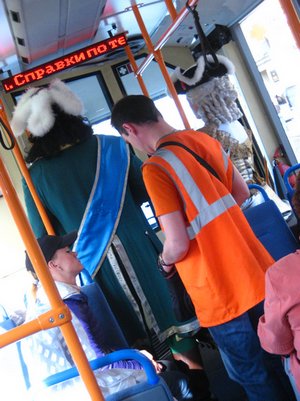
On a bus along Nevsky Prospect.

Life never quite returned to normal for the aristocrats after the revolution, it seems. Nowadays they can be found at various tourist sites around town, posing for photos with visitors for a fee.

Tallin Tales

Simply could not get enough of this camera-friendly Nordic sunshine while in Tallinn, Estonia, in late August! Thought to share a few of my favourite glimpses and nuggets about Tallin’s Old Town, some picked up from our walking tour with EstAdventures, some by meandering on our own.

Below, a sweeping view of Tallin Old Town’s roof tops and spires. Across the water, a 3-hour ferry ride away, lies Finland. Apparently the ferry doesn’t really need to take 3 hours, but it does so that it can maximise sales of (relatively) cheap booze to daytripping Finns!

IMG 1838

On 20th August 1991, Estonia declared (a local might say reclaimed) independence from the Soviet Union. Large boulders such as this one below were placed at major road intersections, set up to be obstacles to the tanks that Estonians feared would roll in from Moscow.

IMG 1822

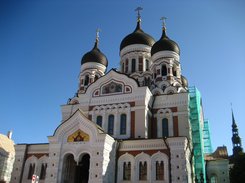
Today, a gigantic and magnificently ornate Russian Orthodox church sits right across from the (pink) Estonian Parlianmentary building. Some locals view this as a spiteful reminder of Mother Russia’s influence given 1) Those who identify themselves as native Estonians are more likely to be Lutherans, who worship in spartan church halls; and 2) the Russian government — who is said to provide financial support for this church — spent so much of the Communist regime suppressing religion.

IMG 1826IMG 1830

An evocative outdoor theatre in Old Town.

IMG 1674

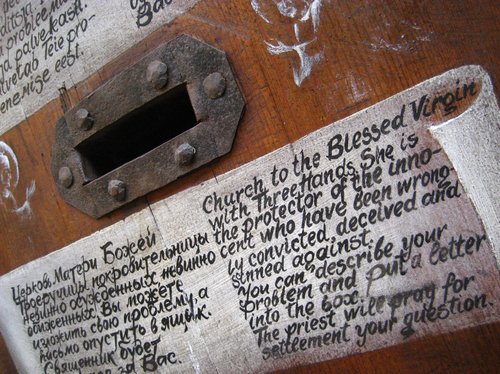
Evidently, what people did before they had Aunt Agony columns and blogs and Twitter as ranting platforms. I love the little detail of the 3D-effect of the painting on the door.

IMG 1733

The little lighthouse above the sign for the Maritime Museum.

IMG 1743

A few steps from the Maritime Museum, a boy wearning a gas mask (I have no idea why) sits on the memorial that marks the tragic sinking of the passenger ferry “Estonia” in 1994 while enroute between Tallinn and Stockholm.

IMG 1742

This little al fresco set up of an Italian restaurant took my breath away — to the extent that I took a photo of this rather than the leg of jamon on display in the window! I don’t know much about design, but I really do like the look of the wooden wine crates being used as flower pots.

IMG 1880

Doesn’t the lovely light against the medieval walls make you want to go?

IMG 1676

“So what was it like to be a university student here right when the Communist Government was falling from power?” I asked Peter, founder of Peter’s Walking Tours in St Petersburg, Russia. As luck would have it, Peter was our guide on our accidentally private tour this late August morning.

Given Peter and I both studied film in university (him in St Petersburg smack at the start of the historic early 1990s) and then later both did stints as newspaper journalists, we had plenty to banter about besides the sights.

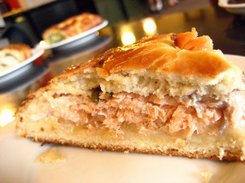
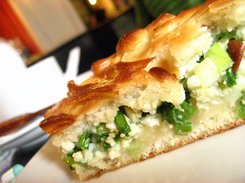
My favourite part of chat was over salmon and green onion & egg pie at Stolle, which serves fabulous sweet and savoury pies unique to St Petersburg, stemming from the city’s pre WWI history of hosting many an academic German expat in its university district, one of the main areas of our walking tour. The pie crusts below look like brick, but actually taste and feel like brioche.

IMG 2076IMG 2080IMG 2081

Peter responded that among he and his friends here in St Petersburg at least, politics wasn’t actually their first concern at the time. Rather, it was how to access food.

Under communist rule, all food transport, distribution and sales networks throughout the Soviet Union had been controlled by the central government. So while there was food still being grown and stored out in say, the ‘Stans, there was no functioning system to move the food to cities, let alone price it. A market system eventually filled the gap, clearly, said Peter, but it didn’t just pop up overnight. And during that awful vacuum, people were quite hungry and afraid indeed.

A living lesson in the fragility of food security.

But those dark days had a lighter side, it seems. International aid organizations soon parachuted into town, and distributed food on the university campus. But by this time, everyone in the city also had food ration coupons… including vodka coupons! So each week, after coupons were issued, Peter and friends — with their campus food aid socked away — would run around town looking for teetotalling old biddies to trade in their food coupons for the old women’s vodka coupons.

“That was a fantastic time!” said Peter with a smile, amused at his own nostalgia.

Another highlight of the walking tour for me a stroll through Andreevsky Market Place (located close to Andreevsky Cathedral on Vasileostrovkaya Island), where nary a tourist (except us) was in sight.

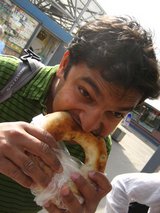
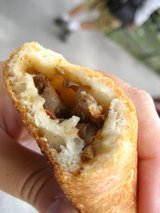
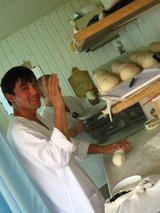
We stop at an Uzbek bakery for meat donuts. Yes indeedy. Meat donuts. While Babs and Peter deal through the retail window, I pop my head in through the back door to get this shot of their tandoori-esque oven.

IMG 2087

We bite into the donut, and decide we have to get ourselves out into the ‘Stans at some point. One of the bakers smiles and waves at me through the door, and then hollers “I love you!”

I’m going to assume that’s simply all the English he knows.

IMG 2089IMG 2103IMG 2088

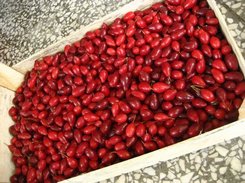
A melon stall run by a guy I wouldn’t want to meet in a dark alley. I can’t decide if telling him “nice melons” will make his smile or piss him off. On the right, some kind of sour cherry, apparently, but I couldn’t get the exact name of it. Please enlighten me if you know what these are called!

IMG 2090IMG 2095

Caviar for the proletariat. Red caviar is usually from salmon and trout. I developed quite a taste for these paired with blinis (Russian crepes) during our time in Russia. Couldn’t afford the black (sturgeon) variety.

IMG 2091

While wandering around Tallinn, Estonia, in late August this year, we stumbled onto the town’s flower festival, right under Tallin Old Town’s much photographed towers. Delightfully, this year’s theme centred on edible plants, so I thought to share some of my favourite sights from the day.

All these shots were taken on my tiny but trusty Canon Ixus 65; the close-ups using digital macro mode. I was quite pleased with the results — a testament to Nordic sunshine!
IMG 1686

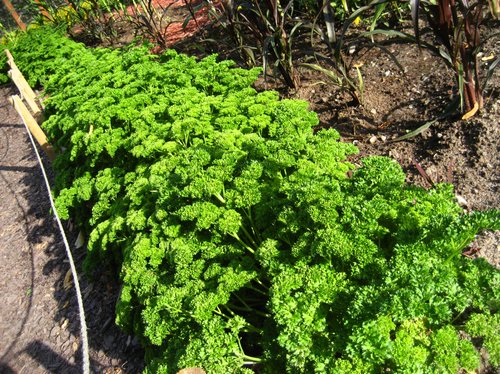
Someday I’m going to try this at home: a curly parsley hedgerow.

IMG 1691

Lil Miss Sunshine wins the popularity contest.

IMG 1698

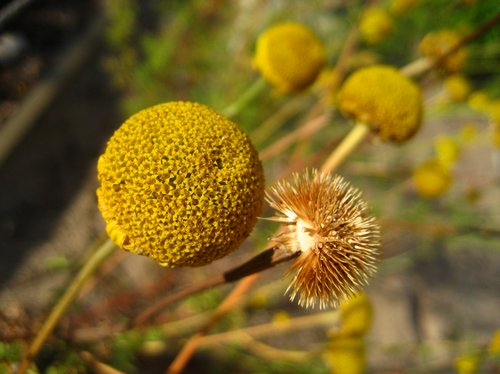
I think these are dandelions, but I’d never seen this bulbous kind before. I’m looking forward to learning how to better use them in salads and tea, when I have a kitchen again.

IMG 1726

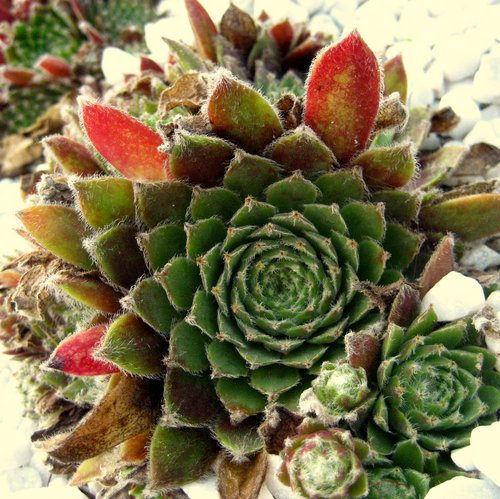
Not sure what this is, but thought the fractal patterns were cool.

IMG 1712

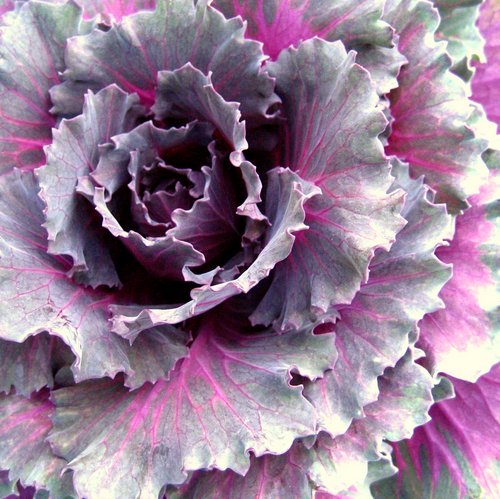
Saved my favourite for last — I’ve never seen purple cabbage look so glamourous!

IMG 1719

Enjoying everything in Tanzania… except the internet signal. Posts with photos will have to be backlogged until we get back to Nairobi at the end of the week. In the meantime, a few quick narrowband notes.

Tanzania: A(rusha) to Z(anzibar)

It took 19 hours in 2 buses, half an hour in a tuktuk, 4 hours on a slow boat, 10 minutes in a taxi, 5 overnight stays, a lot of haggling, and even more bone rattling on half-paved highways to get to Jambiani beach here on the east coast of fabled Zanzibar Island.

But damn it’s worth it!

The sun, the sea, the sand and the sky is every bit as ludicrous as they’re hyped to be. Just the humble tide pools here are awash with hermit crabs, sea snails, sea urchins, fish egg sacs and starfish… the snorkeling this afternoon should be interesting.

And admittedly, we ate very well on the road (you can’t be that surprised by now). In Arusha – pit stop for travelers headed for the Serengeti and Mount Kilimanjaro alike – we had a fantastic Pakistani BBQ. In Dar Es Salaam, we had authentic Sichuan hotpot thanks to a tipoff from G-Star, a friend from work. Zanzibar – for all its hailed exoticness, got us right in the gut because so many of its flavours and aromas remind of our Indian and Straits Chinese upbringing respectively! More detailed posts to come.

Google’s Got My Goat!

In other news, I just found out that YouTube’s disabled my “Babs killing the goat” video because it apparently violates YouTube Community Guidelines! How Babs could ever be a violation of a community guideline I’ll never know…

Jokes aside, I’m taking it in stride because it’s a fair concern. Having the full context of the blog post is one thing (and even that was understandably rough viewing for quite a few readers) and I should have made sure to make sure that context was available on the You Tube page as well. A lesson to be shared with fellow food bloggers! I’ve included more context on the YouTube page now, so let’s see if YouTube will relinquish the video…otherwise I’ll need to seek out more enlightened video hosting alternatives when I make it back to Broadband land.

But overall, I’ve been very encouraged by the wide range of responses to the goat post. Thanks guys! Some cheered us on as fellow foodies, some said the post confirmed their belief in vegetarianism, some said that the post was making them think about whether they were really ok about eating meat. Fantastic. It’s all good, whatever decision you come to – the key thing is that the post made you more conscious about how food gets to your plate.

My favourite response, however, came from my grandmother via an email from Mum. Grandma is a constant reminder that all my adventures, at the end of the day, stand on her shoulders. Here’s what Mum wrote:

“While we were at Grandma’s place yesterday, uncle Steven showed her the blog on the goat slaughtering. I was observing her grimace but thought she was braver than Dad. Ming (Wen: my brother) was watching too but turned away before the end. Then she told us the story of her 1st experience of slaughtering a chicken when she was 12. The chicken got up and ran away. She stood there crying until the chicken dropped dead as there was no one around to help her. Then she went to pick it up and continued with the cleaning and cooking process amidst her tears. What a story!”

I can’t wait to see Grandma when I’m back in Singapore for Chinese New Year next February.

Kenyan Goat Feast

IMG 5245

Prologue:

  • First things first. This is not going to be a pretty blog post. As a meat eater I decided it was important for me to experience something like this at some point, to see if I could face the reality of the process of getting meat to my plate. Vegetarians and animal lovers, proceed with caution.
  • This post is dedicated to my Dad, with whom I used to watch Keith Floyd’s culinary adventures around the world. We’d always have a good chuckle at his “wing it and swig it” approach to cooking and life. I’d like to think that Dad watches me undertake my many a hare-brained adventure with a similar bemusement.
  • Finally, this goat feast was very much a team effort. Thanks to Michael Odula for helping us source the goat, Samuel Odula for showing Babs how to kill it with minimal suffering, our fellow volunteers Dan and Cyrill for first raising the idea, co-financing this whopping 1,500 Kenyan shilling (~£13) enterprise, and being amazing comrades-in-arms throughout our stint. Finally thanks to the kids — Michael Jr, Tanya, Gloria et al for being fabulous team players on the day.

So. Our fellow WWOOFer Dan walks into our living room on Rusinga Island in West Kenya one day and says “Hey I heard these WWOOFers back in July bought a whole goat and BBQed it. Are you interested in us pitching in to get one too?”

I say “YES”, probably about as fast as I said yes when Babs proposed. Just possibly a wee bit faster.

And then Babs ups the ante (as he does): “Yes, but only if we buy a live goat and I get to kill the goat myself.”

The week leading up to feast day was surprisingly unhyped. We simply agreed on a budget for a medium-sized goat and our homestay host Michael Odula spent a morning and an afternoon asking around if anyone in the neighbourhood had a goat from their flock for sale. He appointed his youngest son Samuel to help us through the kill.

D-Day. Our goat had arrives before breakfast. We went out to find it chilling out and snacking on a bush. Samuel reckons it weighs about 50kg. I get Babs to pose next to it for perspective.

IMG 5058

Samuel takes the goat out to a stone plateau behind the Odula house and trusses it up. Under his guidance, Babs cuts deep into the goat’s throat with Dan’s camping knife. The key thing here is to cut right through the jugular. It’s a steady hand and a sharp blade, and the goat stops moving in less than 3 minutes. There’s less of a blood spurt than we expected.

Being behind the camera provides a strange sense of detachment but it’s still a fairly intense experience watching my first food-animal kill. I wasn’t sure if I would feel nauseous (I didn’t) or feel huge pangs of guilt (I didn’t either, given the goat had lived outdoors all its life, had a quick death, and we were damn well going to eat it nose to tail.)

It could have been scarier. Had we been with a more traditional tribe, they would have cut a pouch of skin under the goat’s neck to catch the blood, then drink it as part of the ritual. I’m not ready to go that native.

A moment of solemn silence, and then Babs unties the goat in preparation for the next task…

IMG 5066IMG 5073

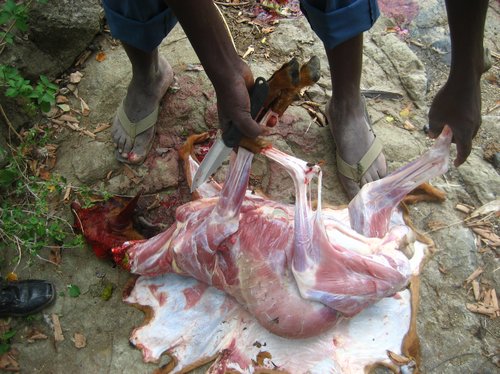
…Skinning it. This requires some help from Michael Jr (back) and a neighbour (front) to hold up the legs while gentle but firm slits are made down the middle of the belly and down each leg.

IMG 5089IMG 5102

Next, the shoulders are removed at the joints — surprisingly easily, says Babs.

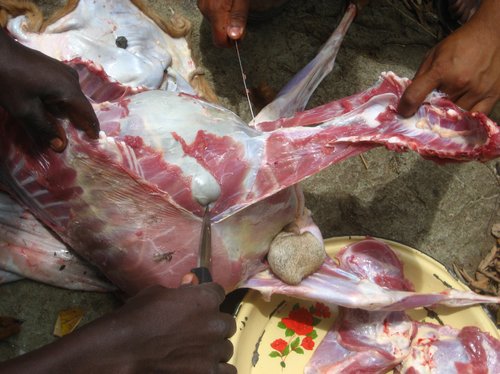
And now to remove the belly flap. This is to be done with great care so as not to puncture the stomach and contaminate the meat with half-digested stomach contents.

IMG 5114

Samuel removes the guts into one neat pile.

IMG 5125

Samuel and Babs section the ribs and joint the legs.

IMG 5136IMG 5143

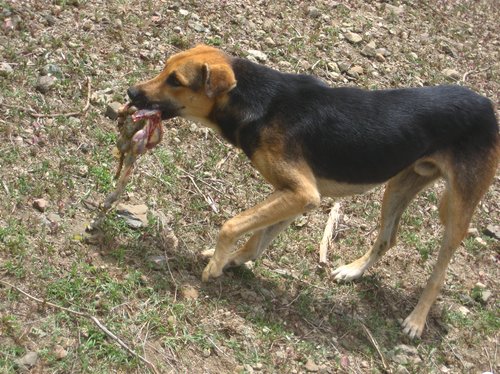
A neighbourhood dog gets a treat of spleen, lungs and kidneys. Later I remove the hooves and he comes back for those. He proceeds to follow me around for the rest of the day…hoping.

IMG 5161

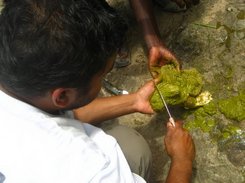
Samuel and Babs do the initial round of cleaning out half-digested greens from the small intestines. There’s a lot of it. The smell, while not knock-you-out overpowering, is distinct and sticks in your head. Now I can always smell a goat (or their poop) that’s anywhere in a 10m radius.

And now to empty out and scrape clean(ish) the stomach….all 4 of them.

IMG 5168IMG 5172

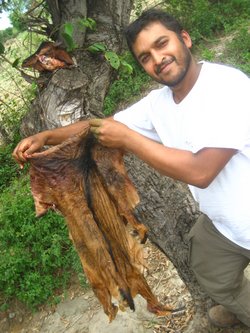
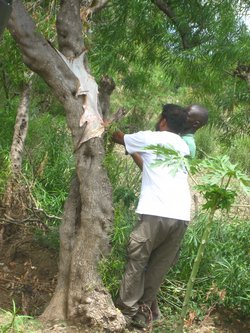
Samuel and Babs wash and scrape fat from the goatskin, then nail it as high as they can on a nearby tree in the hope that the dogs won’t get to it overnight. Idiotically we forgot this when we left — we’ve asked Cyrill to wear it home to Frankfurt as a cape or something. Very Heart of Darkness, no?

IMG 5188IMG 5193

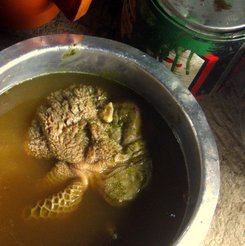
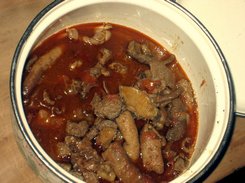
Mama Odula panfries the liver on her charcoal cooker. The stomach and guts need a long hard soak and scrub before they’ll be ready for cooking. Lunch consists of a stew of whatever goat meat bits that won’t be used for the nyama choma (Kenyan-style BBQ) dinner.

IMG 5194IMG 5197

After lunch I get down to marinading the legs and ribs. Am keeping it simple as Floyd would have done. Wash the meat thoroughly. Place in basin. Pour Coca Cola into basin to tenderise the meat. Swig the rest of the bottle. This cooking with Coke business amuses the kids to no end. Floyd might have used local Tusker beer instead, but there was none available at our neighbourhood trading post.

Anyway, back to it. Divide 4-6 large garlic cloves into thick slices, make deep incisions in the legs, and stuff the garlic into the slits. Rub a generous amount of Royco mchuzi mix, the ubiquitous food seasoning found in these parts… Royco is a Unilever powdered concoction of cornstarch, salt, sugar, coriander cinnamon, fennel seeds, tumeric, ginger, garlic, cumin, methee seeds, flavour enhancers — must be MSG I reckon — and permitted food colouring, whatever that is.

IMG 5198

I rope in Tanya to wave away the flies while the meat soaks.

IMG 5226

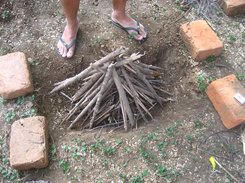
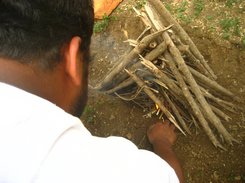
Dan and Babs dig a hole for the fire in our “front yard” and pile up twigs and branches by size. We use dried corn cobs and corn hairs for firestarters. Not that I’ve ever had one, but I absolutely cannot ever go back to gas BBQ grills after this.

IMG 5205IMG 5211IMG 5213IMG 5216

Waiting impatiently for the fire to reach optimum heat…

IMG 5219

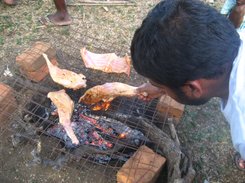
And away we go! 30 minutes of grilling, turning and basting…

IMG 5233IMG 5235

And then, perfection.

IMG 5241

Samuel was quite keen about grilling the goat’s testicles…unfortunately due to the coarseness of the grill mesh Samuel accidentally dropped both into the flames while cooking them. He was quite despondent.

In the Odula living-cum-dining room, Babs carves up the legs, and Mama Odula brings in the matumbo: chopped up stomach, liver, braided intestines… and tongue(?) stewed for hours in cooking fat, tomatoes and onions (and Royco I’m sure, judging by the colour). I try a little for my honour’s sake, but it holds too strong a taste and smell of grass-half-digested-in-stomach-juices for me. Babs digs it though, having grown up with innards curry.

IMG 5294IMG 5296

IMG 5293

Gloria’s had enough talk! It’s time to chow down. Strictly traditional nyama choma doesn’t use any wussy stuff like marinade, so our garlic adds a fabulously novel infusion to the meat.

The ribs — between the Royco and the slow fire — are deliciously smoky. The bits between the ribs could definitely work as a jerky snack.

Mama Odula is well impressed at how tender we’ve kept the meat. Mr Odula asks Babs if he’s ever worked in a restaurant or a hotel.

We spazz out laughing, but we’re pleased at the compliment.

More importantly, we hope we’ve done the goat justice today.

October – Kenya

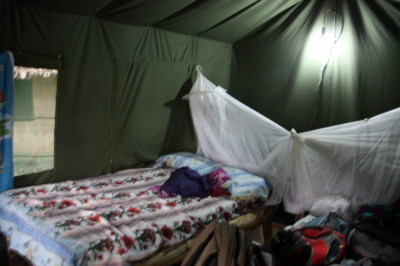
We flew to Nairobi on the 1st of October from Cairo, and stayed a couple of nights in a banda at Upper Hill Campsite in a suburb of Nairobi (ironically not Upper Hill, since they moved from there).

[banda pic to come when I can get power for my camera!]

While there, we signed up for a 4 day safari with Big Time Safaris which would take us to the Masai Mara National Reserve and Lake Nakuru National Park. The safari wasn’t cheap, but we bargained it down to $100 per day (still well over our budget!) which is not too bad since the Kenya Wildlife Service charges foreigners $60 a day to visit its top rated parks and the safari includes food, transport and accommodation.

We saw an incredible number of animals at both parks.

At the Masai Mara we saw: cheetahs, antelopes, Jackson gazelles, lions, elephants, giraffes, zebra, wildebeest, hippos, crocodiles, gnus, warthogs, eagles, hyenas, jackals, maribu storks and no doubt about 100 other species that I didn’t identify or have forgotten already.


Lions

Wildebeest Buffalo

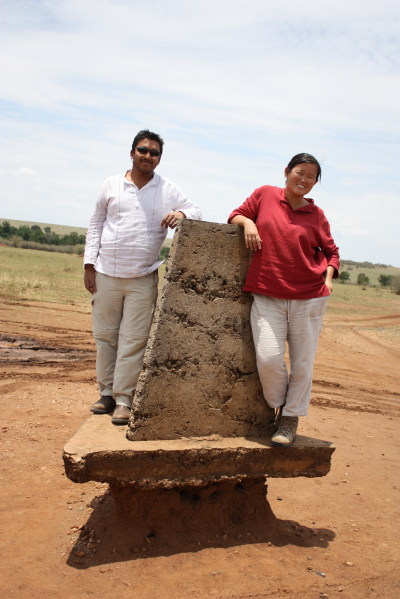
Wabs standing either side of the Kenya-Tanzania border in the Masai Mara

Lake Nakuru was full of flamingos – it’s a soda lake which a large (2 million) population of flamingos migrates to every year. We also saw white rhinos and baboons, in addition to some species which we’d already seen at the Masai Mara.

We had our safari drop us off at Nakuru town, where we stayed a couple of days, before going to Kisumu (3rd largest town in Kenya) for two nights, then getting the bus and ferry to Rusinga Island where we started our two week volunteering stint jsut over a week ago. We’re being teaching assistants at a nursery school in the mornings and working at a permaculture demonstration project in the afternoon, which is all fun, if easy work, and we’re experiencing genuine rural developing country life – ie, no electricity or running water, which is trying our paitence somewhat! Only 5 days to go though!

IMG 1279The main reason I wanted to visit Krakow, Poland, wasn’t food related. Rather, it was to visit the Auschwitz-Birkenau Museum, on the site of the largest Nazi-run extermination camp during World War II.
Below are personal reactions to a few photos I took; by no means any kind of comprehensive write up. For more historical context, Wikipedia provides an excellent starting point.

Auschwitz-Birkenau has been a museum and memorial since 1947 — 2 years after its liberation by Soviet troops — but it was still unnerving to watch a group of visitors get herded through the entrance, under the infamous slogan “Arbeit Macht Frei”, which translates to “Work Brings Freedom”. This phrase greeted prisoners at the gates of several other concentration camps, including Dachau and Sachsenhausen in Germany, and Theresienstadt in the Czech Republic.

IMG 1265

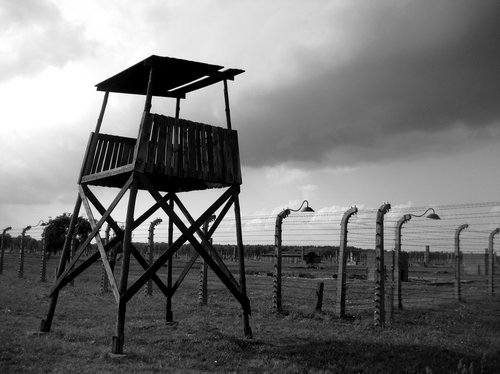
Electrified fences and watchtowers surround and divide camp clusters. This photo for me captures an eerie peacefulness, which in itself is disturbing, knowing that at the time Nazi guards would have shot anyone trying to escape from this vantage point, and many who lost hope would have thrown themselves at the electric fence.

IMG 1271

Given the mass murders in gas chambers using cyanide-based pesticide Zyklon B, I found myself taking photos of any large structure with chimneys. These structures below, however, were the camp kitchens.

Our guide told us that the earliest victims of Zyklon B gassing suffered the most, as the Nazis were trying to figure out the minimum amount needed to get the heinous task done, thus dragging out the poisoning and dying process.

IMG 1262

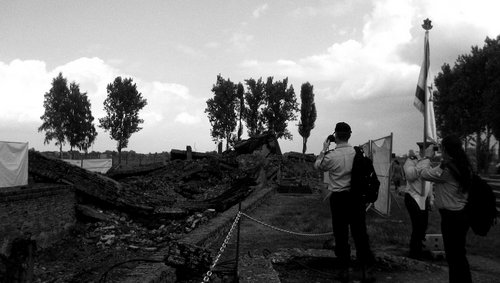
Many of the gas chambers were destroyed by fleeing Nazis, who knew that the arrival of Soviet troops was imminent. The ruins of the gas chambers have been intentionally left in situ. A group of young Israeli soldiers — possibly as part of their national service stint(?) — were visiting the site at the same time as us.

IMG 1275

An old woman wearing the flag of Israel as a cape sits and talks with a few of the young Israeli soldiers. That their conversation is in Hebrew is the only thing I can make out. I don’t know what she’s saying, or whether she’s the assigned guide for the group or a survivor of the camp.

IMG 1290

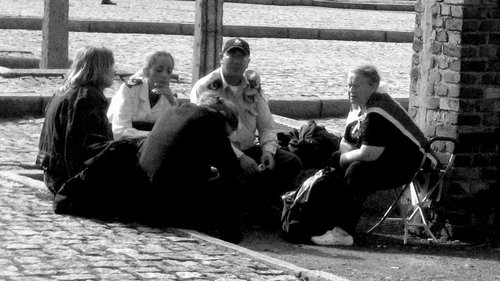
The range of reactions among the visitors was an interesting study in its own right. Some started sobbing at key junctures of the guided tour. Some continued taking photos indoors and carrying on conversations on their mobiles, when both were prohibited.

This man below was quietly walking, then was suddenly overcome with emotion and sat down to compose himself.

IMG 1301

This innocuous looking concrete pond below was one of the most mind boggling and infuriating sights at the camp for me. These ponds were built at the behest of the insurer who underwrote fire coverage for the camp. It speaks to the level of absurd forethought, organisation and corporate collusion in whole affair.

IMG 1299

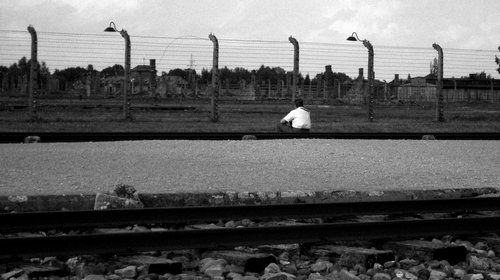
A man, his visit complete, walks towards the exit of Birkenau camp along the train tracks that brought in so many prisoners deported from various corners of Europe. It occured to me that so few individuals would have had the privilege of walking in this direction while the camp was operational.

IMG 1283

I show the above photos in black and white because that’s how I’ve always pictured Auschwitz (too many Hollywood movies I’m sure). I simply wasn’t prepared for how lush the place looked on the mild summer afternoon we visited.

IMG 1315

The immense size of the camp complex — said to be 191 hectares in total (1 soccer field being about 1 hectare in size) — is difficult to digest. The inhabitants of at least 2 towns were booted out so that the Nazis could build and carry out their operations in secrecy.

Our guide, whose grandparents lived in the area at the time, said that even from many kilometres away the smoke and ash and smell of burning flesh was hard to miss, but his grandparents said they had no concept of the scale of mass murders (more than 20,000 gassed per day). Even eyewitness reports from Polish Army Captain Witold Pilecki — who volunteered to be imprisoned to gather information about the camp and its crimes and managed to escape — were discounted by Allied Forces between 1940 and 1943 as exaggerations. Imagine the number of lives lost during that period because of inaction!

Imagine how many lives we, here and now, continue to allow to be lost, every time we hear of a mass injustice somewhere, and do nothing. This particular thought still sits like a rock in my gut.

Travel Tips

Many people visit Auschwitz – Birkenau with a tour group, but it’s very doable to get a train or public bus from Dworzec Glowny, Krakow’s main bus and train station. At the ticketing window, ask for Oswiecim (Auschwitz is the German name for the Polish town). Travel time in either direction is about 90 minutes to 2 hours, depending on traffic. A train might be more comfortable than a bus, but buses run more frequently and will drop you right at the entrance of the camp.

During busy visiting periods (designated months and hours of the day), you have to go through the camp with a guide. The guided tour takes between 3-4 hours, with a bus transit between Auschwitz and Birkenau. Then allow 1-2 hours for wandering around on your own after the guided tour.

There are regular public buses that will take you back to central Krakow. The staff at the information booth can furnish you with a schedule.

For more details, see the museum’s website.