Feeds:
Posts
Comments

Archive for the ‘Reportage’ Category

Moscow: (Food) Gawky Park

IMG 2226

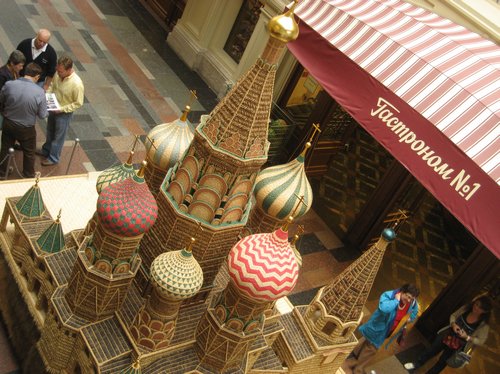
Above: A replica of St Basil’s Cathedral made from grains, at the entrance of the uberposh Gastronom No. 1 Food Hall at the GUM luxury mall on Red Square (right across from Lenin’s tomb, poetically)

Top tip on traveling and eating in Moscow? Go when you have money. Preferably backed by commodity du jour, with a side order of a English Premier League football team. Or else do a massive amount of research beforehand on value-for-money local and street food haunts before showing up. Otherwise, it’s simply a metropolis of slick and expensive restaurants of every ilk of global cuisine. Very exciting for local and expat residents do doubt, but exhausting for a frugal foodie backpacker hoping to chance upon something cheap, cheerful, and core to the indigenous food scene.

Crunched on time and budget, and let down by 2 distinctly budget-busting-but-ultimately-“meh” Georgian restaurants, we did the next best thing to console ourselves; a little food gawking.

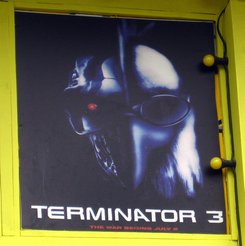
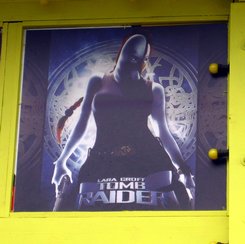
Especially amusing were these signboards below at a fried chicken shop at Gorky Park, the city’s historic sprawling recreation centre and amusement park for locals.
IMG 2294IMG 2295IMG 2297IMG 2298

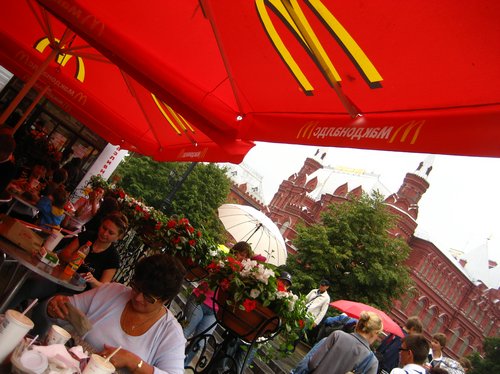
For a while I entertained the idea that the one place on this round-the-world sabbatical that might be appropriate to eat at Micky D’s would be at Moscow’s Red Square. The place was absolutely mobbed (I mean crowded, not necessarily occupied by local goombas). It was a case of Russian Breadlines: The Capitalist Remix. I decided that life was too short and there had to be a better use for my already too-few rubles.
IMG 2271

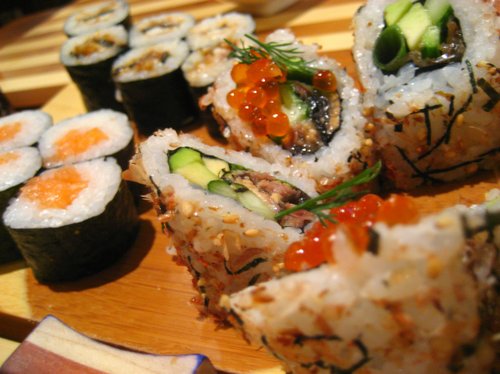
I noted with curiosity that there was a slew of sushi joints all over St Petersburg and Moscow. And peering at diners’ platters from the sidewalk, the sushi actually looked credible. You can kinda tell when a city is just starting to get into sushi but sushi chefs and local palettes haven’t been trained up yet. The rice looks dry and loose grains fall all over the platter. The maguro is an anaemic pink rather than a healthy deep maroon. And people are eating mostly plastic looking california rolls with crabsticks and neon pickles. But this was not the case in Moscow.

According to Peter, our guide in St Petersburg, sushi’s become quite the staple for urban Russia’s aspirational middle class over the last decade or so. Sushi has a great combination of a having designer look and exotic vibe, and apparently is especially popular among young Russian women looking to reduce their stodge intake.

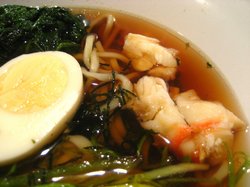
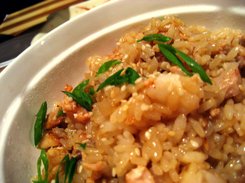
So before camping out at Sheremetyevo Airport for the night to catch a early morning flight to Istanbul, we followed the lead of the locals and had sushi for dinner. We popped into Yakitoriya (a long list of branches throughout Moscow, and a delivery service to boot) where the sushi and ramen were credible for the price.
IMG 2328IMG 2322IMG 2325

Next time I come back here, if ever, I’ll follow my own advice. In the meantime, bring on Istanbul!

Read Full Post »

A few quick glimpses from wandering around St Petersburg, Russia, in late August this year.

Statue of Peter the Great, immortalised in world literature by Pushkin’s The Bronze Horseman, an epic poem about man against the elements. Peter the First envisioned a new coastal capital for the Russian empire… built on a swamp…that would be frozen for a good chunk of the year. Apparently when his engineers told him that this swamp would be completely untenable for building for many months at a time, he said something to the effect of “Well you’d better work faster then”.

IMG 2128

Old men playing chess on Nevsky Prospect.

IMG 1938

Young men dancing in front of the Hermitage Museum. Other youths around them were practising stunt bike and skateboard tricks.

IMG 1985

A boy peers at the eternal flame memorial at Field of Mars for those who died in the Bolshevik Revolution. Right after I took this photo he spat into the flame and scampered away!

IMG 2014

IMG 2056

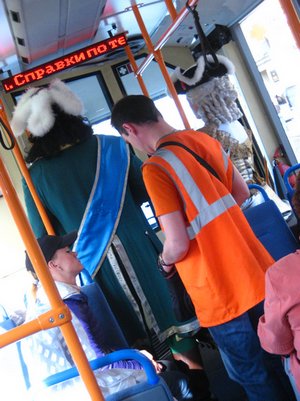
On a bus along Nevsky Prospect.

Life never quite returned to normal for the aristocrats after the revolution, it seems. Nowadays they can be found at various tourist sites around town, posing for photos with visitors for a fee.

Read Full Post »

Tallin Tales

Simply could not get enough of this camera-friendly Nordic sunshine while in Tallinn, Estonia, in late August! Thought to share a few of my favourite glimpses and nuggets about Tallin’s Old Town, some picked up from our walking tour with EstAdventures, some by meandering on our own.

Below, a sweeping view of Tallin Old Town’s roof tops and spires. Across the water, a 3-hour ferry ride away, lies Finland. Apparently the ferry doesn’t really need to take 3 hours, but it does so that it can maximise sales of (relatively) cheap booze to daytripping Finns!

IMG 1838

On 20th August 1991, Estonia declared (a local might say reclaimed) independence from the Soviet Union. Large boulders such as this one below were placed at major road intersections, set up to be obstacles to the tanks that Estonians feared would roll in from Moscow.

IMG 1822

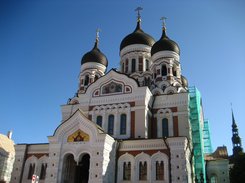
Today, a gigantic and magnificently ornate Russian Orthodox church sits right across from the (pink) Estonian Parlianmentary building. Some locals view this as a spiteful reminder of Mother Russia’s influence given 1) Those who identify themselves as native Estonians are more likely to be Lutherans, who worship in spartan church halls; and 2) the Russian government — who is said to provide financial support for this church — spent so much of the Communist regime suppressing religion.

IMG 1826IMG 1830

An evocative outdoor theatre in Old Town.

IMG 1674

Evidently, what people did before they had Aunt Agony columns and blogs and Twitter as ranting platforms. I love the little detail of the 3D-effect of the painting on the door.

IMG 1733

The little lighthouse above the sign for the Maritime Museum.

IMG 1743

A few steps from the Maritime Museum, a boy wearning a gas mask (I have no idea why) sits on the memorial that marks the tragic sinking of the passenger ferry “Estonia” in 1994 while enroute between Tallinn and Stockholm.

IMG 1742

This little al fresco set up of an Italian restaurant took my breath away — to the extent that I took a photo of this rather than the leg of jamon on display in the window! I don’t know much about design, but I really do like the look of the wooden wine crates being used as flower pots.

IMG 1880

Doesn’t the lovely light against the medieval walls make you want to go?

IMG 1676

Read Full Post »

“So what was it like to be a university student here right when the Communist Government was falling from power?” I asked Peter, founder of Peter’s Walking Tours in St Petersburg, Russia. As luck would have it, Peter was our guide on our accidentally private tour this late August morning.

Given Peter and I both studied film in university (him in St Petersburg smack at the start of the historic early 1990s) and then later both did stints as newspaper journalists, we had plenty to banter about besides the sights.

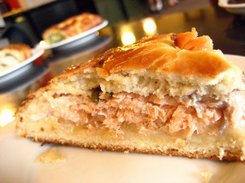
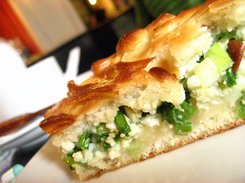
My favourite part of chat was over salmon and green onion & egg pie at Stolle, which serves fabulous sweet and savoury pies unique to St Petersburg, stemming from the city’s pre WWI history of hosting many an academic German expat in its university district, one of the main areas of our walking tour. The pie crusts below look like brick, but actually taste and feel like brioche.

IMG 2076IMG 2080IMG 2081

Peter responded that among he and his friends here in St Petersburg at least, politics wasn’t actually their first concern at the time. Rather, it was how to access food.

Under communist rule, all food transport, distribution and sales networks throughout the Soviet Union had been controlled by the central government. So while there was food still being grown and stored out in say, the ‘Stans, there was no functioning system to move the food to cities, let alone price it. A market system eventually filled the gap, clearly, said Peter, but it didn’t just pop up overnight. And during that awful vacuum, people were quite hungry and afraid indeed.

A living lesson in the fragility of food security.

But those dark days had a lighter side, it seems. International aid organizations soon parachuted into town, and distributed food on the university campus. But by this time, everyone in the city also had food ration coupons… including vodka coupons! So each week, after coupons were issued, Peter and friends — with their campus food aid socked away — would run around town looking for teetotalling old biddies to trade in their food coupons for the old women’s vodka coupons.

“That was a fantastic time!” said Peter with a smile, amused at his own nostalgia.

Another highlight of the walking tour for me a stroll through Andreevsky Market Place (located close to Andreevsky Cathedral on Vasileostrovkaya Island), where nary a tourist (except us) was in sight.

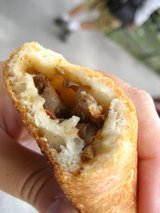
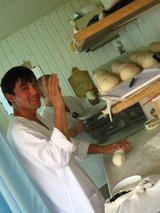
We stop at an Uzbek bakery for meat donuts. Yes indeedy. Meat donuts. While Babs and Peter deal through the retail window, I pop my head in through the back door to get this shot of their tandoori-esque oven.

IMG 2087

We bite into the donut, and decide we have to get ourselves out into the ‘Stans at some point. One of the bakers smiles and waves at me through the door, and then hollers “I love you!”

I’m going to assume that’s simply all the English he knows.

IMG 2089IMG 2103IMG 2088

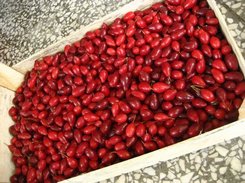
A melon stall run by a guy I wouldn’t want to meet in a dark alley. I can’t decide if telling him “nice melons” will make his smile or piss him off. On the right, some kind of sour cherry, apparently, but I couldn’t get the exact name of it. Please enlighten me if you know what these are called!

IMG 2090IMG 2095

Caviar for the proletariat. Red caviar is usually from salmon and trout. I developed quite a taste for these paired with blinis (Russian crepes) during our time in Russia. Couldn’t afford the black (sturgeon) variety.

IMG 2091

Read Full Post »

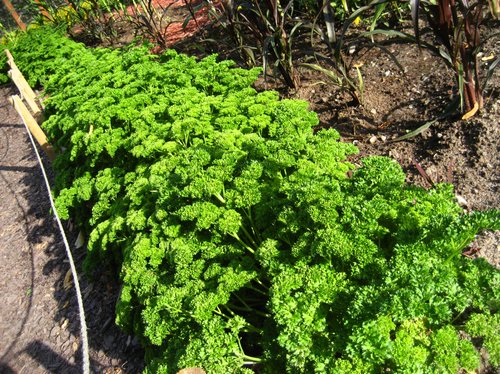
While wandering around Tallinn, Estonia, in late August this year, we stumbled onto the town’s flower festival, right under Tallin Old Town’s much photographed towers. Delightfully, this year’s theme centred on edible plants, so I thought to share some of my favourite sights from the day.

All these shots were taken on my tiny but trusty Canon Ixus 65; the close-ups using digital macro mode. I was quite pleased with the results — a testament to Nordic sunshine!
IMG 1686

Someday I’m going to try this at home: a curly parsley hedgerow.

IMG 1691

Lil Miss Sunshine wins the popularity contest.

IMG 1698

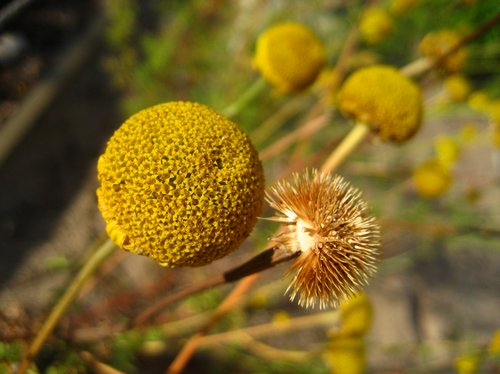
I think these are dandelions, but I’d never seen this bulbous kind before. I’m looking forward to learning how to better use them in salads and tea, when I have a kitchen again.

IMG 1726

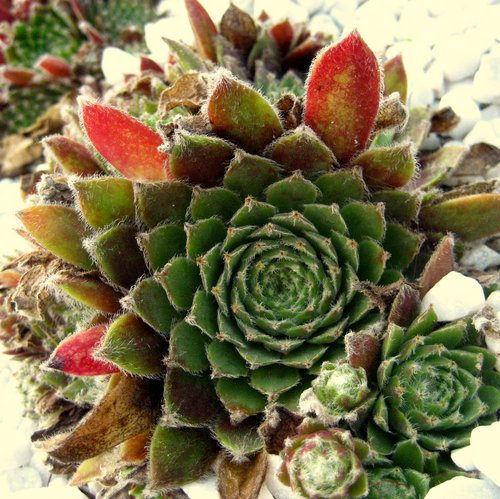
Not sure what this is, but thought the fractal patterns were cool.

IMG 1712

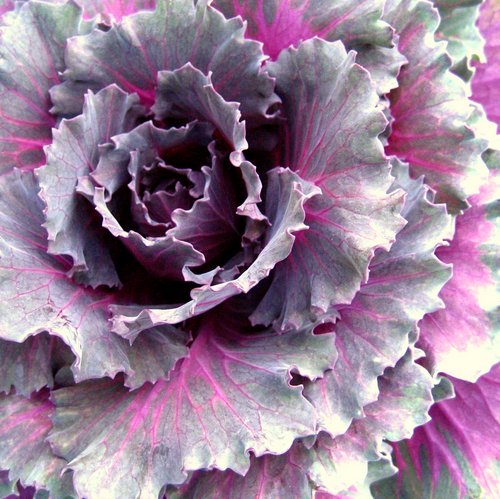
Saved my favourite for last — I’ve never seen purple cabbage look so glamourous!

IMG 1719

Read Full Post »

Enjoying everything in Tanzania… except the internet signal. Posts with photos will have to be backlogged until we get back to Nairobi at the end of the week. In the meantime, a few quick narrowband notes.

Tanzania: A(rusha) to Z(anzibar)

It took 19 hours in 2 buses, half an hour in a tuktuk, 4 hours on a slow boat, 10 minutes in a taxi, 5 overnight stays, a lot of haggling, and even more bone rattling on half-paved highways to get to Jambiani beach here on the east coast of fabled Zanzibar Island.

But damn it’s worth it!

The sun, the sea, the sand and the sky is every bit as ludicrous as they’re hyped to be. Just the humble tide pools here are awash with hermit crabs, sea snails, sea urchins, fish egg sacs and starfish… the snorkeling this afternoon should be interesting.

And admittedly, we ate very well on the road (you can’t be that surprised by now). In Arusha – pit stop for travelers headed for the Serengeti and Mount Kilimanjaro alike – we had a fantastic Pakistani BBQ. In Dar Es Salaam, we had authentic Sichuan hotpot thanks to a tipoff from G-Star, a friend from work. Zanzibar – for all its hailed exoticness, got us right in the gut because so many of its flavours and aromas remind of our Indian and Straits Chinese upbringing respectively! More detailed posts to come.

Google’s Got My Goat!

In other news, I just found out that YouTube’s disabled my “Babs killing the goat” video because it apparently violates YouTube Community Guidelines! How Babs could ever be a violation of a community guideline I’ll never know…

Jokes aside, I’m taking it in stride because it’s a fair concern. Having the full context of the blog post is one thing (and even that was understandably rough viewing for quite a few readers) and I should have made sure to make sure that context was available on the You Tube page as well. A lesson to be shared with fellow food bloggers! I’ve included more context on the YouTube page now, so let’s see if YouTube will relinquish the video…otherwise I’ll need to seek out more enlightened video hosting alternatives when I make it back to Broadband land.

But overall, I’ve been very encouraged by the wide range of responses to the goat post. Thanks guys! Some cheered us on as fellow foodies, some said the post confirmed their belief in vegetarianism, some said that the post was making them think about whether they were really ok about eating meat. Fantastic. It’s all good, whatever decision you come to – the key thing is that the post made you more conscious about how food gets to your plate.

My favourite response, however, came from my grandmother via an email from Mum. Grandma is a constant reminder that all my adventures, at the end of the day, stand on her shoulders. Here’s what Mum wrote:

“While we were at Grandma’s place yesterday, uncle Steven showed her the blog on the goat slaughtering. I was observing her grimace but thought she was braver than Dad. Ming (Wen: my brother) was watching too but turned away before the end. Then she told us the story of her 1st experience of slaughtering a chicken when she was 12. The chicken got up and ran away. She stood there crying until the chicken dropped dead as there was no one around to help her. Then she went to pick it up and continued with the cleaning and cooking process amidst her tears. What a story!”

I can’t wait to see Grandma when I’m back in Singapore for Chinese New Year next February.

Read Full Post »

IMG 1279The main reason I wanted to visit Krakow, Poland, wasn’t food related. Rather, it was to visit the Auschwitz-Birkenau Museum, on the site of the largest Nazi-run extermination camp during World War II.
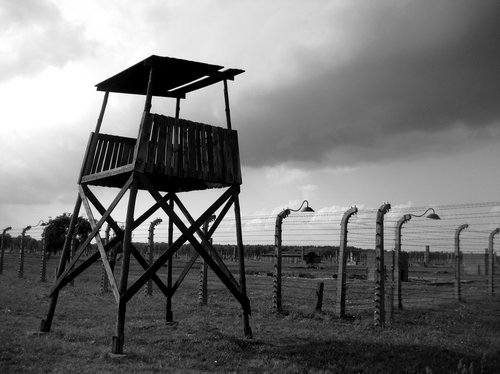
Below are personal reactions to a few photos I took; by no means any kind of comprehensive write up. For more historical context, Wikipedia provides an excellent starting point.

Auschwitz-Birkenau has been a museum and memorial since 1947 — 2 years after its liberation by Soviet troops — but it was still unnerving to watch a group of visitors get herded through the entrance, under the infamous slogan “Arbeit Macht Frei”, which translates to “Work Brings Freedom”. This phrase greeted prisoners at the gates of several other concentration camps, including Dachau and Sachsenhausen in Germany, and Theresienstadt in the Czech Republic.

IMG 1265

Electrified fences and watchtowers surround and divide camp clusters. This photo for me captures an eerie peacefulness, which in itself is disturbing, knowing that at the time Nazi guards would have shot anyone trying to escape from this vantage point, and many who lost hope would have thrown themselves at the electric fence.

IMG 1271

Given the mass murders in gas chambers using cyanide-based pesticide Zyklon B, I found myself taking photos of any large structure with chimneys. These structures below, however, were the camp kitchens.

Our guide told us that the earliest victims of Zyklon B gassing suffered the most, as the Nazis were trying to figure out the minimum amount needed to get the heinous task done, thus dragging out the poisoning and dying process.

IMG 1262

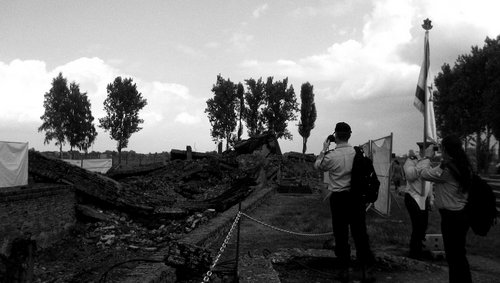
Many of the gas chambers were destroyed by fleeing Nazis, who knew that the arrival of Soviet troops was imminent. The ruins of the gas chambers have been intentionally left in situ. A group of young Israeli soldiers — possibly as part of their national service stint(?) — were visiting the site at the same time as us.

IMG 1275

An old woman wearing the flag of Israel as a cape sits and talks with a few of the young Israeli soldiers. That their conversation is in Hebrew is the only thing I can make out. I don’t know what she’s saying, or whether she’s the assigned guide for the group or a survivor of the camp.

IMG 1290

The range of reactions among the visitors was an interesting study in its own right. Some started sobbing at key junctures of the guided tour. Some continued taking photos indoors and carrying on conversations on their mobiles, when both were prohibited.

This man below was quietly walking, then was suddenly overcome with emotion and sat down to compose himself.

IMG 1301

This innocuous looking concrete pond below was one of the most mind boggling and infuriating sights at the camp for me. These ponds were built at the behest of the insurer who underwrote fire coverage for the camp. It speaks to the level of absurd forethought, organisation and corporate collusion in whole affair.

IMG 1299

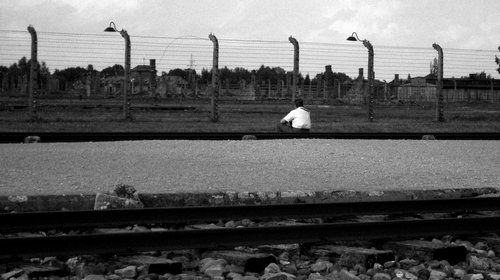
A man, his visit complete, walks towards the exit of Birkenau camp along the train tracks that brought in so many prisoners deported from various corners of Europe. It occured to me that so few individuals would have had the privilege of walking in this direction while the camp was operational.

IMG 1283

I show the above photos in black and white because that’s how I’ve always pictured Auschwitz (too many Hollywood movies I’m sure). I simply wasn’t prepared for how lush the place looked on the mild summer afternoon we visited.

IMG 1315

The immense size of the camp complex — said to be 191 hectares in total (1 soccer field being about 1 hectare in size) — is difficult to digest. The inhabitants of at least 2 towns were booted out so that the Nazis could build and carry out their operations in secrecy.

Our guide, whose grandparents lived in the area at the time, said that even from many kilometres away the smoke and ash and smell of burning flesh was hard to miss, but his grandparents said they had no concept of the scale of mass murders (more than 20,000 gassed per day). Even eyewitness reports from Polish Army Captain Witold Pilecki — who volunteered to be imprisoned to gather information about the camp and its crimes and managed to escape — were discounted by Allied Forces between 1940 and 1943 as exaggerations. Imagine the number of lives lost during that period because of inaction!

Imagine how many lives we, here and now, continue to allow to be lost, every time we hear of a mass injustice somewhere, and do nothing. This particular thought still sits like a rock in my gut.

Travel Tips

Many people visit Auschwitz – Birkenau with a tour group, but it’s very doable to get a train or public bus from Dworzec Glowny, Krakow’s main bus and train station. At the ticketing window, ask for Oswiecim (Auschwitz is the German name for the Polish town). Travel time in either direction is about 90 minutes to 2 hours, depending on traffic. A train might be more comfortable than a bus, but buses run more frequently and will drop you right at the entrance of the camp.

During busy visiting periods (designated months and hours of the day), you have to go through the camp with a guide. The guided tour takes between 3-4 hours, with a bus transit between Auschwitz and Birkenau. Then allow 1-2 hours for wandering around on your own after the guided tour.

There are regular public buses that will take you back to central Krakow. The staff at the information booth can furnish you with a schedule.

For more details, see the museum’s website.

Read Full Post »

Just about when Babs was feeling like all these farmers markets looked a bit samey, my case for dawdling with a camera got renewed (whew!) when we came across these giant alien-looking discs at the traditional Stary Kleparz Market in Krakow, Poland.

After circling a few times, peering at them up close, and prodding them a little, we finally realised that these were, essentially, a large bag of sunflower seeds in their original packaging. (This may be far more obvious to some of you, but certainly not to this city girl at the time.)

IMG 1208

To put the above in context, here’s a sunflower in the middle of the seeding process, which I photographed at a flower show in Tallinn, Estonia, a couple of weeks later.

IMG 1701

Another first-time find at Stary Kleparz Market: these luscious tomato-shaped peppers.

IMG 1219

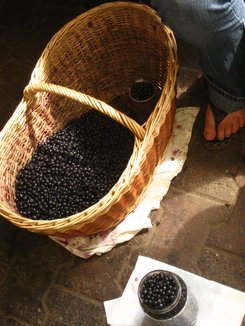
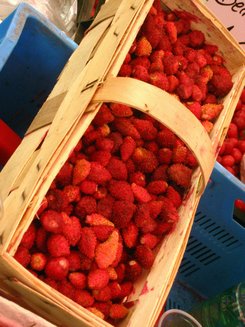
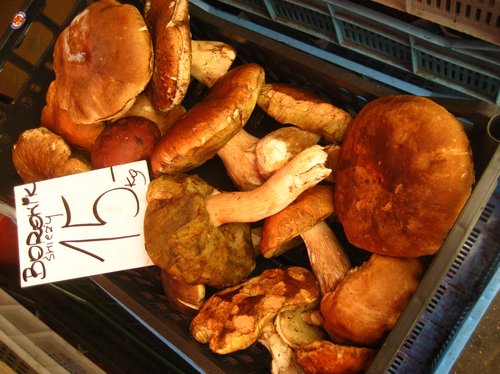
It being August at the time meant that locals were currently enjoying the best of 2 seasons: late summer berries, and early autumn wild mushrooms. Some stalls had mountains of both, but there were plenty of locals simply hawking just one basket of whatever they foraged or grew at home, e.g., blueberries and wild strawberries sold by the cupful.

IMG 1209IMG 1217

The lack of a kitchen pained me greatly when I saw these heaps of bulbuous porcini. Fortunately, the popular Polish restaurant U Babci Maliny (which delightfully translates as Grandmother Raspberry) served up a mushroom soup that did them justice (read the post here).

IMG 1211

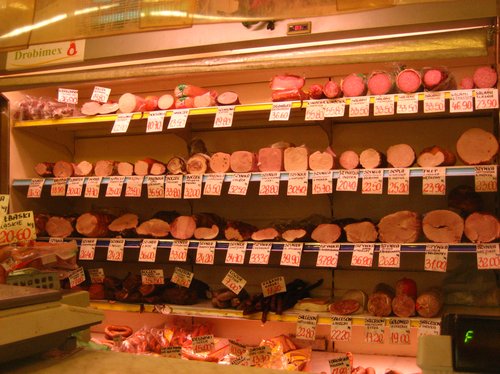
The Poles take their pork pretty seriously. I’m not sure I’ve seen a ham display this large anywhere else. Not even in Spain. Well, not this well organized, at least.

IMG 1224

IMG 1226Given Krakow is on Poland’s landlocked southern side, most of the fish we saw was smoked or pickled. Up north, freshwater fish such as carp, perch and eel from native lakes are popular picks for regional cuisine.
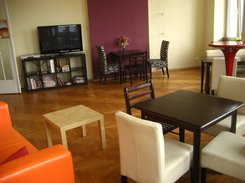
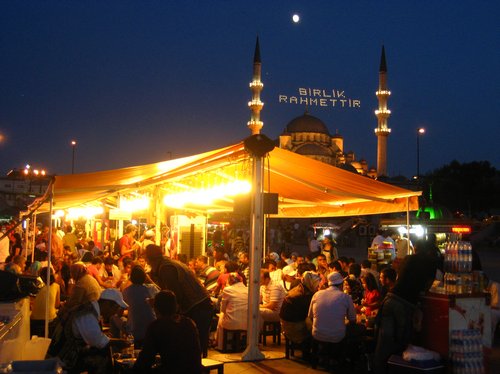
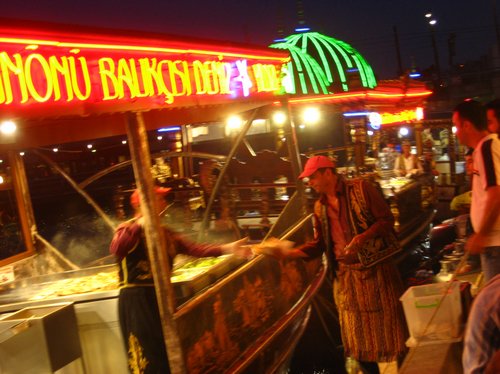
GlobArt Hostel , where we stayed, is just round the corner from the market, which made for cheerfully cheap and downright delicious lunches, with a view of Krakow’s Old Town.

IMG 1233

Read Full Post »

Fast Break-fasts in Istanbul

Still plowing through notes and photos from Central and Eastern Europe, but given it’s already halfway through Ramadan, I thought to skip forward briefly to the action in Istanbul.

Ramadan — or Ramazan, for the Turks — is the annual month-long fast for Muslims. Any eating or drinking is done sans sunlight. The most electric time of day this time of year, therefore, is just as the prayer call at dusk commences, signalling the break of the day’s fast. Food vendors and their customers — having been poised at the starting blocks — bound like coiled springs into a blur of lentil soups, mezzes and pides before digging into heavier meatier fare.

Restaurants all over town offer special Ramazan feast menus, but feeling fairly budget-battered after emerging from Russia, Babs and I mostly followed my street-urchin palette around town. I am delighted to say, Istanbul more than delivered.

IMG 2443

Above: Evening breakfast by the fish sandwich boats at the Eminonu end of the Galata Bridge

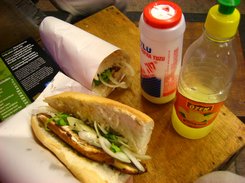
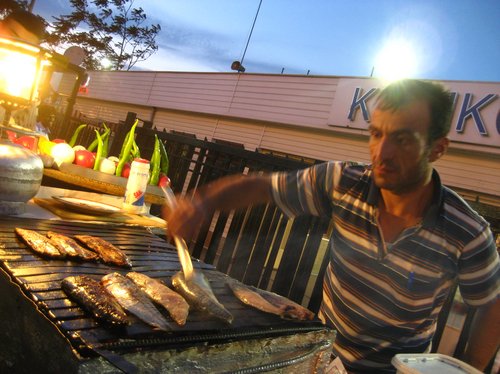
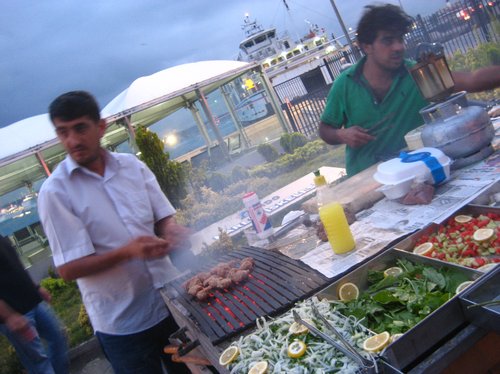
One of the most fun, overload-your-senses way to break-fast in Istanbul is to join the crowd under the fish sandwich tents, at the Eminonu end of the Galata Bridge. Mackeral fillets are fried en-masse on viciously bobbing boats a mere few inches from you (I felt sea-sick just trying to take this photo below).

IMG 2445

There’s salt and lemon juice at every table for you to jazz up your 4-lira sandwich, and plenty of colourful pickle carts nearby if you want a side dish.

IMG 2448IMG 2477

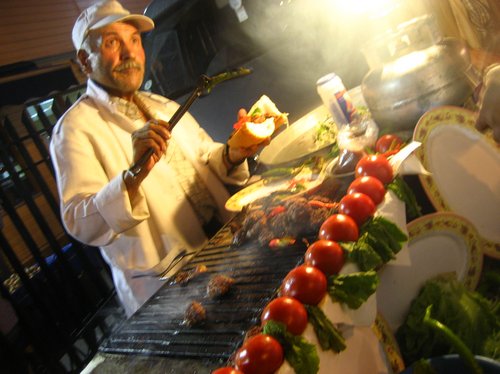
If you’re good to eat on your feet, however, look for the pushcart vendors just a few steps away. This gentleman’s mackeral fillets were thicker, had more bite (which means they were fresher), had that lovely irreplaceable smokiness of a charcoal flame, and cost only 3 lira.

IMG 2440

I am still slightly sore at Babs for scarfing more than his fair share of the sandwich we shared — he ruthlessly played the “you snooze you lose” card because I was running around snapping photos. Unfortunately, if tried by a jury of our peers, I know his defence would hold.

Only one way to remedy that. Move on to the kofte (spicy meatballs) sandwich cart a few steps on. Yes, I would like a toasted green chilli with that, please, Uncle. Absolutely gorgeous. And only 2 lira! Gawd I love this city.

IMG 2462

What’s this, what’s this? A 2-grill pushcart, one for fish and one for kofte! And a DIY salad bar to boot! I found these street-cuisine geniuses at Sirkeci, right outside the entrance to the ferry to the Harem bus station across the water.

IMG 3297

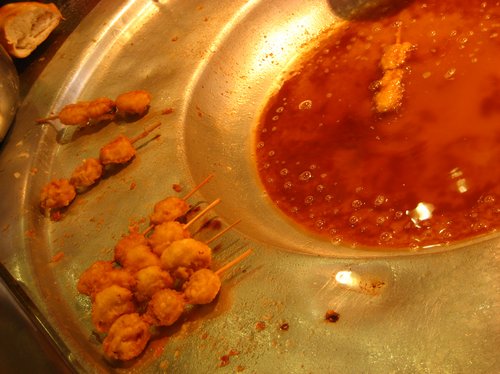
All that grilling and greens too healthy for you? How about some battered and deep fried mussels? Many touristy fish restaurants will have a mussel-stand for the casual passer-by. We found this one on Sahne Sokuk, just off Istikal Caddesi in Beyoglu.

IMG 2602

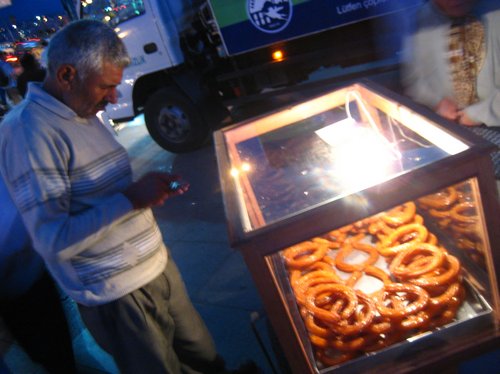
To end your break-fast stroll on a sweet note, grab some tulumba — deep fried dough drizzled (regularly, throughout the day… urk!) with sugar syrup. Sold as long pretzel-like rings, as below, and thumb-length stubs.

IMG 2560

Fast Breaking News: Free Dinner at Fast-Breaking Tents

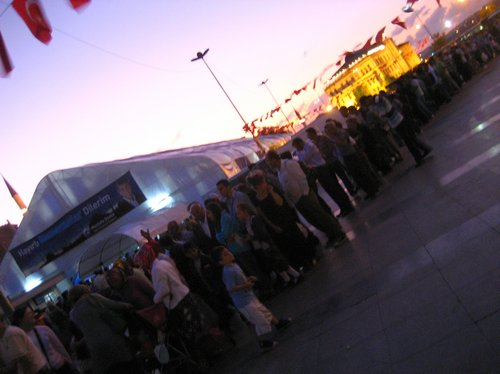
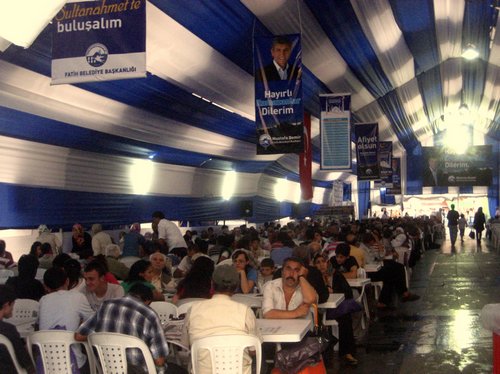
The most popular break-fast treat in town is evidently in one of the city’s many iftar (break-fast) tents, sponsored by local councils. The queues start some 2 hours before dusk, and according to a friendly security guard, this tent feeds about 1,500 people a day. City-wide, Istanbul hosts some 100 tents and according to Turkish English-language newspaper TodaysZaman expects to feed some 300,000 people this Ramazan at the cost of US$15m.

IMG 2559


In principle the iftar tents are meant to provide food for the poor and those who are not able to prepare dinner at home because of work — in Islam it’s considered a good deed to feed those who have been fasting. It seems plenty of locals join in simply for the festive community atmosphere. We also saw a few tourists in line. In the end we decided we couldn’t join in in good conscience — our budget wasn’t that battered, we’re not local taxpayers, and I haven’t even been fasting — but the friendly security guard lets me poke my head in to take this photo.

IMG 3257

Hayirli Ramazanlar, folks. Going hungry — especially on a voluntary basis — has never been a strong point with this particular foodie, so may God look very kindly on you.

Read Full Post »

Babs and I spent 1 night in Zagreb at the start of August, as a transit point between Dubrovnik and Prague. We spent 1 day exploring Upper Town — made up of the historical clerical distrct called Kaptol, and the merchant and tradesman stronghold called Gradec — and the next day wandering the parks and government monuments of Lower Town.

Smack in the middle of it all, up the steps from Ban Jelacic Square, was my favourite part of the city — Dolac Market, where we bought and made lunch on both days for less than €4 per person.

IMG 0745

IMG 0812Dolac Market was built between 1926 and 1930, when city authorities decided to level an inner city slum and replace it with a destination more palatable to visitors’ eyes. The market is currently open from 6am – 2pm each day, and until 3pm on Saturdays.
Its centrepiece is an armada of red-and-white striped umbrellas sheltering fruit, vegetable and local craft vendors. On the far side of the square is a stairway and elevator that leads you down to 2 covered storeys of meat and cheese vendors.

The market square is ringed with cafes and bars, where you can perch and watch the grazing and haggling action, or better yet, grab a borek (cheese, spinach or meat-stuffed filo) and kava to line your stomach and clear your head sufficiently, then wade into the thick of it yourself.

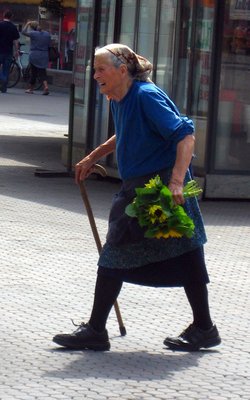
We did just fall off the overnight bus from Dubrovnik, but geez, the old women around here look like they’re made pretty much of the same stuff as the statue above. So, bleary-eyed schmleary-eyed! Stiff upper lip, chug another double expresso, and in we go…

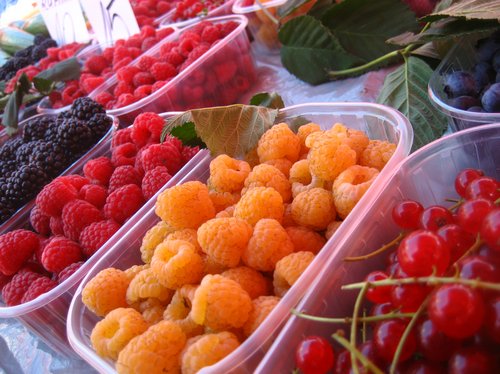
Turns out, the kaleiscope of colours will jolt you awake anyway. Given it was the height of summer at the the time, there was an explosion of berries. A new find for me were these pretty yellow raspberries.

IMG 0755

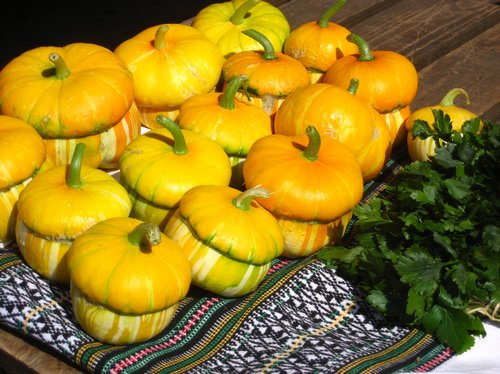
I’d seen curiously shaped pettipans in UK farmers markets before, but never ones of this muffin shape. Anyone know if they grow this way naturally, or if they are forced into this shape? (A long time ago as a cub reporter I covered a story on the Japanese growing cube-shaped watermelons in a bid for easier transport. Each baby watermelon would be placed in a box, and the box would be replaced with a larger one as the melon grew. I don’t get the sense the idea caught on, given the amount of faff required.)

IMG 0758

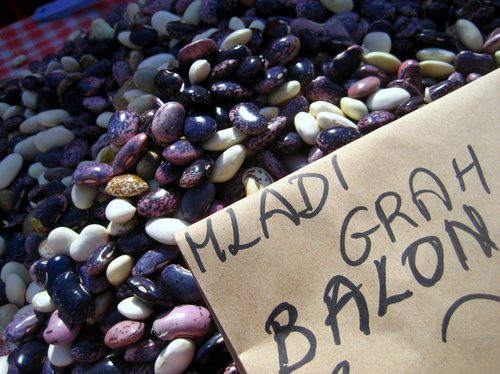
Another first for me — these gorgeous beans of varying shades and speckles of purple, freshly shelled by stallholders. You’d think they were jellybellys!

IMG 0748

IMG 0786 On to the indoor meat section one floor below. I felt my arteries clog just at the sight of this shelf full of pork crackling (this photo’s for you Jas!)
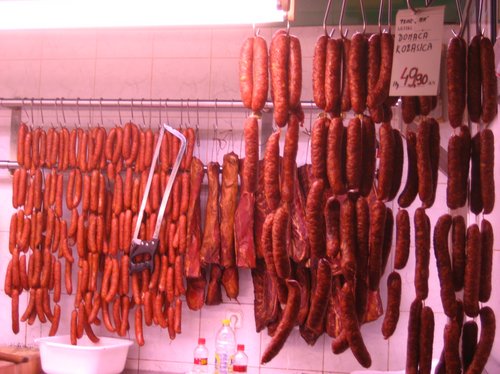
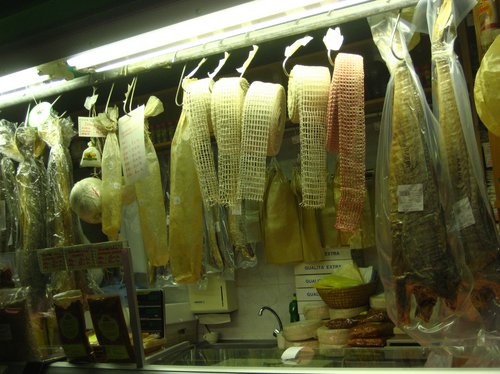
There were smoked meats and sausages everywhere, from different animals, using different spice blends, from different makers and regions.

And just in case you had a hankering for something different from all that was on offer, there was a stall that sold sausage casings and nettings for you to make your own at home.

IMG 0766IMG 0767

And now to the cheese wing. If you hear a lot of “Sir” this and “Sir” that around here, it’s not that these vendors are extra formal. Sir is the local word for cheese. The local make seems to be a mild, salty and sometimes curdy cross between ricotta and mozzerella, made simply in plastic bowls. Some had been smoked for a stronger taste. I was especially amused by the cheese cones. Sadly, these were mostly targeted at local home-based buyers and we weren’t able to buy a small tourist-sized portion (or maybe we just lost too much in translation…).

We got a good taste of the goods however, as many stallholders were keen to show off their wares and give us a sample to nibble on. Hvala ti, ladies!

IMG 0782

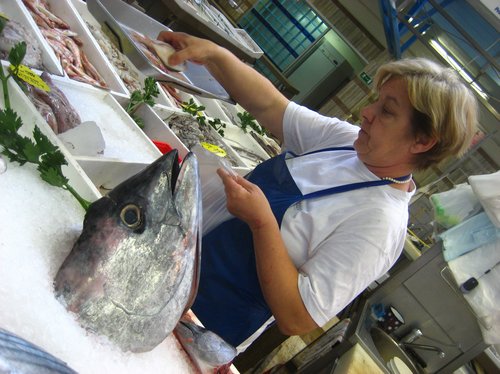
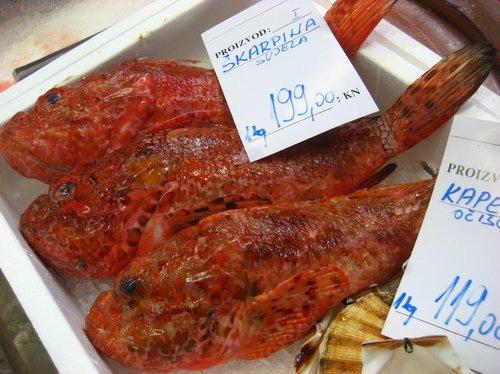
The fishmongers had their own off-shoot building. The range wasn’t anything to scream about, but I was amused by this helmet-sized tuna head. Also, we saw some of the skarpina we had at Restaurant Lindo in Dubrovnik, in their original state. Very pretty.

IMG 0839IMG 0837

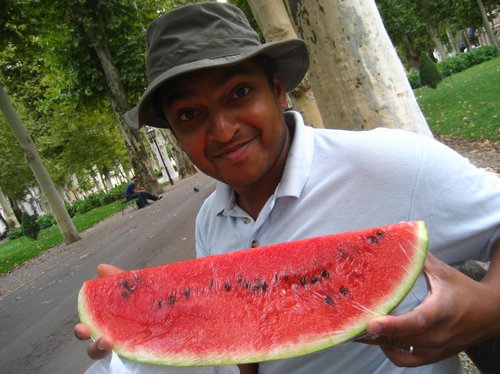
On top of providing hours of entertainment, local markets are a great way to very eat well on a tight budget. We could barely eat or drink anything else after this 1.5kg slice of watermelon, bought for ~€1. The plums and blueberries would have to wait, but there might just be enough room for that half of a rotisserie chicken…

IMG 0842

Read Full Post »

« Newer Posts - Older Posts »